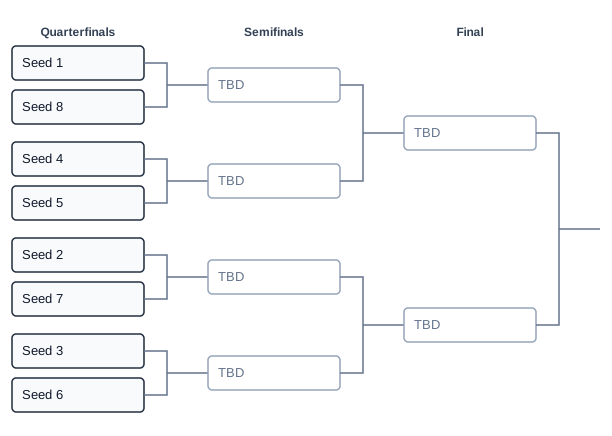
A cornhole tournament bracket is a diagram that pairs up teams for each round of a cornhole tournament, tracking winners as games to 21 are played until one team is left standing. Add your teams below and download a PDF or SVG without an account.
8 Team Cornhole Tournament Bracket
Your single-elimination draw · Scroll across to follow each round. Download to print the full bracket.
Want scores and winners to update online?
Your event name, teams and seed order carry over. Live brackets up to 8 teams are free. Choose a sport, then generate the live draw.
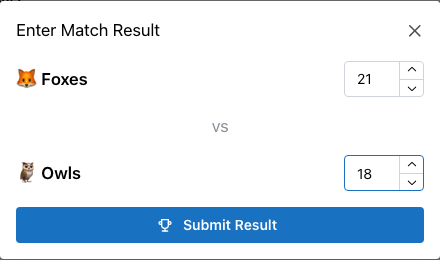
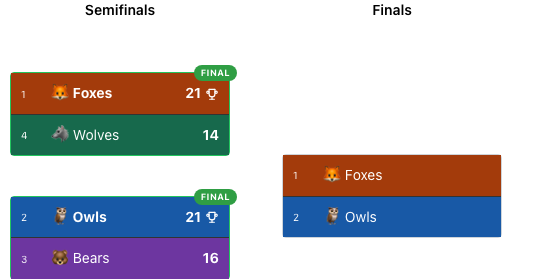
A live bracket gives you a scoring view and a public link for players and spectators. Here is the actual product with a fictional four-team event. Team colors shown are a Pro configuration.
On your scoring screen, enter both scores and select Submit Result. A draw needs a winner.Share the public bracket link. Spectators see results and advancing teams without an account. These are screenshots; enter your own teams in the builder above.
Running a Cornhole Tournament Bracket
A cornhole tournament bracket assigns teams to matchups, tracks who wins each game, and advances winners toward a champion. Whether it's a backyard cookout or a bar league night, a printed bracket keeps everyone clear on who plays who and when — no arguing over who's up next.
Assigning Teams and Bag Colors
Before the bracket starts, get every team's names and bag color locked in so there's no confusion mid-game — cornhole sets typically come in two colors, so teams sharing a color need a second set or a coin flip to decide who throws which bags. Write team names directly into the bracket slots once you know the seeding, or draw for random seeds if it's a casual event.
Scoring to 21
Under ACA rules, a bag in the hole scores 3, a bag on the board scores 1, and only the difference is awarded each inning. Reach or exceed 21 at the end of an inning to win. Publish any house-rule changes before starting.
Running Multiple Boards for a Backyard or Bar Tournament
The biggest thing that keeps a cornhole bracket moving is board availability. For example, seven 20-minute games need 140 minutes on one court. Two courts can finish in four waves (80 minutes), before breaks and overruns. Bar tournaments with several sets of boards can run an entire round simultaneously, then rotate the bracket to the next round once every game finishes.
Backyard and bar cornhole tournaments usually run 8 or 16 teams, playing in pairs (two players per team) or singles. 8 teams is the most common size for a casual backyard cookout, while bar leagues and larger events often scale up to 16.
Single elimination is the default for a quick backyard event — it's fast and keeps things moving. Bar leagues and more competitive tournaments often prefer double elimination, since a single bad toss shouldn't end a team's day; see our double elimination bracket at /8-team-double-elimination-bracket.
An 8-team single-elimination bracket needs 7 games. As a planning example, 20-minute games take 140 minutes on one court or four playing waves (80 minutes) on two courts, before breaks and overruns. A court uses a pair of boards.
Each side pitches four bags per inning, eight bags total between opponents. In doubles, partners stand at opposite ends and take turns pitching innings.
Cancellation scoring is the standard cornhole rule where bags on the board and in the hole cancel out between opposing teams — only the team with more points that round scores the difference. Most tournament brackets use cancellation scoring by default; confirm the rule with your event organizer before the first game.
For anything beyond a 4-team tournament, running two or more boards at the same time keeps the bracket moving and avoids a long wait between rounds. Bar tournaments with 16+ teams typically run 3-4 boards simultaneously.