
The organizer’s format guide
Choose the right tournament format.
A fast knockout draw, a full round robin, or pools into playoffs? Compare the match count, playing time, and experience each format gives your teams.
Start free · No credit card · Spectators don’t need an account
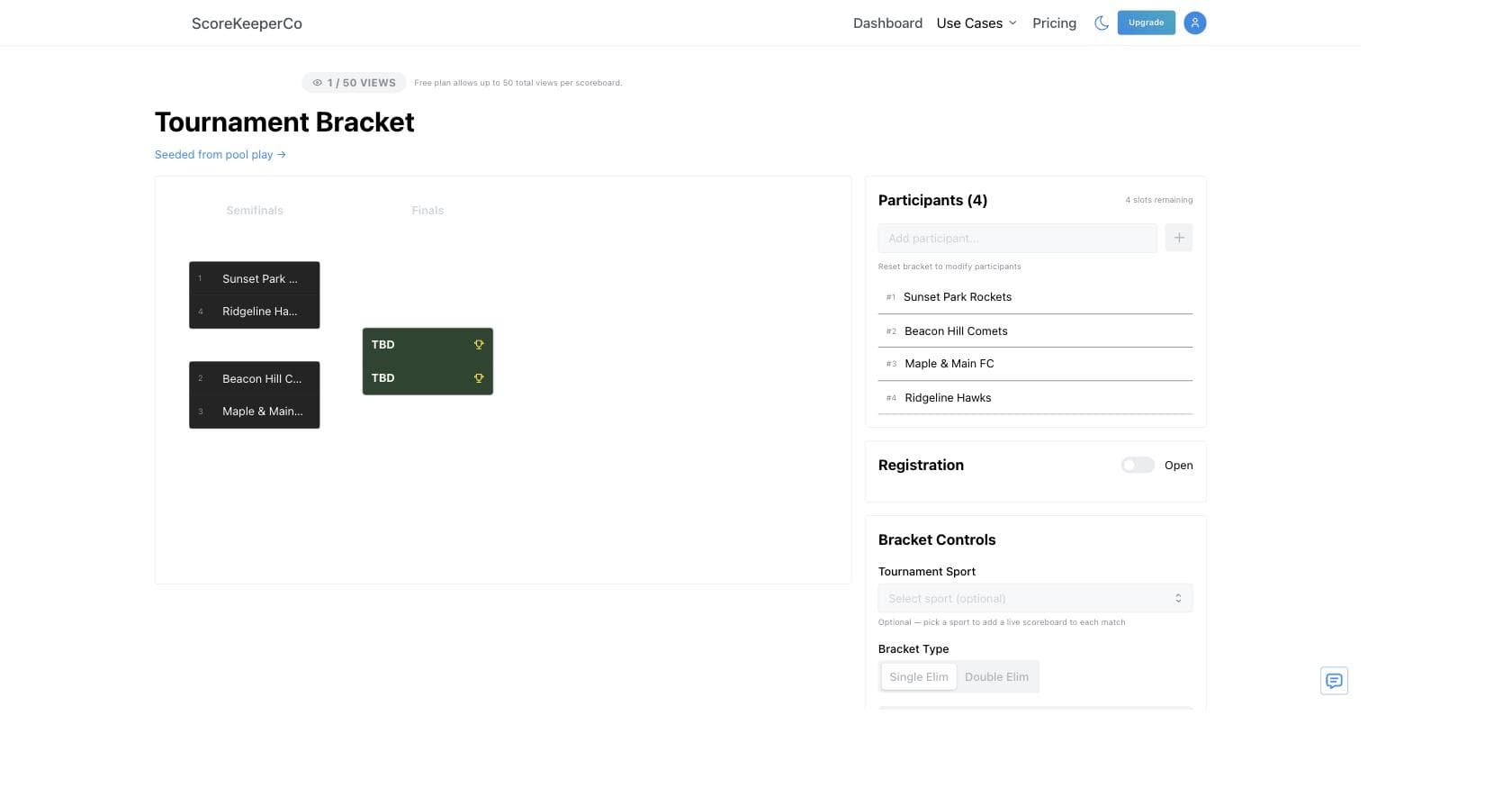
Four common ways to find a winner
Start with the promise you make to teams.
Decide whether every entrant should get several matches or whether a short path to a champion matters more. Then work out the court time. A larger field does not automatically need a more complicated format.
| Format | Matches for N teams | Why choose it | Tradeoff |
|---|---|---|---|
| Single elimination | N − 1 | A clear champion with the fewest matches | A team can be eliminated after its first played match |
| Double elimination | 2N − 2, or 2N − 1 with a reset final | A second chance after the first loss | More matches and a less predictable finish time |
| Single round robin | N(N − 1) / 2 | Every team meets every other team | Match count grows quickly as the field gets larger |
| Pool play → playoffs | Add each pool’s round robin matches, then the playoff matches | Group games for everyone, then a decisive final stage | You must specify pool balance, tiebreakers, and qualifiers |
These counts describe played matches, excluding byes, third-place matches, and withdrawals. Double elimination assumes each loss eliminates nobody until a second loss, with a championship structure that can reset. If your event uses a modified final, publish that rule explicitly.
Try the math for your own event
How many matches—and how much court time?
Change the team count, format, courts, and match-slot length. The model schedules rounds in sequence so teams cannot be assigned to two rounds at the same time.
Include warmup and changeover in each slot.
Matches to plan for
31
Playing time with round-by-round scheduling
4h 30m
4 balanced pools (4 + 4 + 4 + 4 teams). Top two per pool advance to a 8-team single-elimination playoff. Pool rounds finish before playoffs begin.
Planning estimate, not a published schedule. Add check-in, breaks, team rest, officiating duties, and an overrun buffer. No third-place match is included.
Method: a round robin uses the circle-method round count, including a rotating bye for odd fields. Pool play balances groups of up to four, advances two from each group, and adds a single-elimination playoff. Courts are reused in waves within each round. The calculator does not add rest intervals or referee assignments.
A worked example, not just a formula
The same 16 teams can mean 15, 31, or 120 matches.
| Setup | Calculation | Matches |
|---|---|---|
| Single elimination | 16 − 1 | 15 |
| Double elimination | 2 × 16 − 2; add one if the final resets | 30–31 |
| One full round robin | 16 × 15 / 2 | 120 |
| Four pools of four, top two advance | 4 × 6 pool matches + 7 playoff matches | 31 |
Why dividing games by courts can mislead: in an eight-team knockout bracket on four courts, quarterfinals use all four courts, semifinals use two, and the final uses one. Seven games still need three sequential match slots. The final cannot start while its semifinalists are still playing.
For the 16-team pool example on four courts, pool play needs six waves and the eight-team playoff needs three more. At 30 minutes a slot, that is 4 hours 30 minutes of playing slots. Add your breaks, warmup policy, check-in, and overrun buffer before advertising an end time.
Make the draw understandable
Seeds, byes, and qualifiers are different decisions.
- 01
Seeds order the field
Ranked seeds can keep the strongest entrants apart until later rounds. Use a random draw when you do not have a defensible ranking. Explain which approach you use.
- 02
Byes fill the bracket
A 12-team knockout uses a 16-slot bracket with four byes. A bye advances a team without a played match. The event still needs 11 actual matches to produce a champion.
- 03
Qualifiers leave the pools
Publish the number of advancing teams and the tiebreak order before play. Decide how pool finishers map into the playoff draw rather than changing it after results are known.
Continue with the tournament seeding guide for practical draw examples, or the pool-play guide for the group-to-playoff workflow.
Turn the plan into a tournament.
Create a knockout bracket
Preview the opening round with your team names and carry your roster into a live board.
Start a bracket →Create round robin matchups
Generate a complete schedule for a small field, with print and CSV options.
Use the schedule maker →Plan a volleyball event
Apply the format math to court time, pool matches, and playoff rounds.
Open the volleyball planner →Questions before you start?
What is the fastest tournament format?
Single elimination uses the fewest played matches to find one winner: N−1 for N teams. Actual event duration still depends on court count, round dependencies, match length, and breaks.
Is pool play the same as round robin?
Pool play is a group stage; round robin is a way to schedule matches within a group. A tournament can run round robin matches inside several pools and then advance selected teams into a knockout bracket.
How many games are in a 16-team pool-play tournament?
It depends on pool size and advancement. Four pools of four play six round robin matches each, for 24 pool matches. Advancing two per pool creates an eight-team single-elimination bracket with seven matches: 31 total, excluding any third-place game.
Does a bye count as a game?
No. A bye advances a participant without a played match. In single elimination, the total number of played matches remains N−1, even when the field is not a power of two.
Is double round robin the same as double elimination?
No. Double round robin means every pairing plays twice. Double elimination means a participant leaves after two losses. They have different match counts and scheduling requirements.
Prepared by ScoreKeeperCo · Reviewed September 14, 2026. Planning examples describe the stated formats; your sport or event rules may add constraints.
READY WHEN YOU ARE
A format that fits. A tournament ready to run.
Build the draw, bring in your teams, and give everyone one place to follow the action.