Singles & fixed-partner doubles
A pickleball round robin, ready for your courts.
Enter one player or fixed doubles pair per team slot. Get every matchup, rotate byes for odd fields, and print or download your court assignments. No signup to plan your games.
Start free · No credit card · Spectators don’t need an account
Add your players or fixed pairs.
For singles, enter one player per slot. For fixed doubles, enter a pair such as Alex & Jamie in one slot. This generator keeps pairs together; it does not rotate partners between rounds.
Court numbers repeat when a round needs more matches than you have courts. Play those matches in successive waves. Review rest and shared-player conflicts before publishing; this tool does not enforce them.
Work out the court time before inviting everyone.
The calculator counts team entries, so eight doubles pairs means eight teams and sixteen players. Match-slot length is your planning assumption; add breaks and overrun time separately.
Include warmup and changeover in each slot.
Matches to plan for
120
Playing time with round-by-round scheduling
12h 30m
Every team plays 15 matches. Each round finishes before the next begins; odd fields rotate a bye.
Planning estimate, not a published schedule. Add check-in, breaks, team rest, officiating duties, and an overrun buffer. No third-place match is included.
| Courts | Playing waves | At 25 minutes per slot |
|---|---|---|
| 2 | 14 | 5 hours 50 minutes |
| 4 | 7 | 2 hours 55 minutes |
Sixteen teams in a single full round robin need 120 matches. Four pools of four followed by an eight-team playoff need 31. Compare both approaches in the pickleball tournament planner.
Choose the right kind of round robin.
| Format | What to enter | How matches work |
|---|---|---|
| Singles | One player per team slot | Every player faces every other player |
| Fixed doubles | One pair per team slot | Pairs stay together and face every other pair |
| Rotating-partner mixer | Use a dedicated rotation tool | Not generated here; the pairings must change between rounds |
Publish scoring and tiebreak rules before play. The generator creates matchups; it does not verify player ratings or submit rating results. A registration form can collect the division and partner information you need to review.
Turn your plan into a tournament.
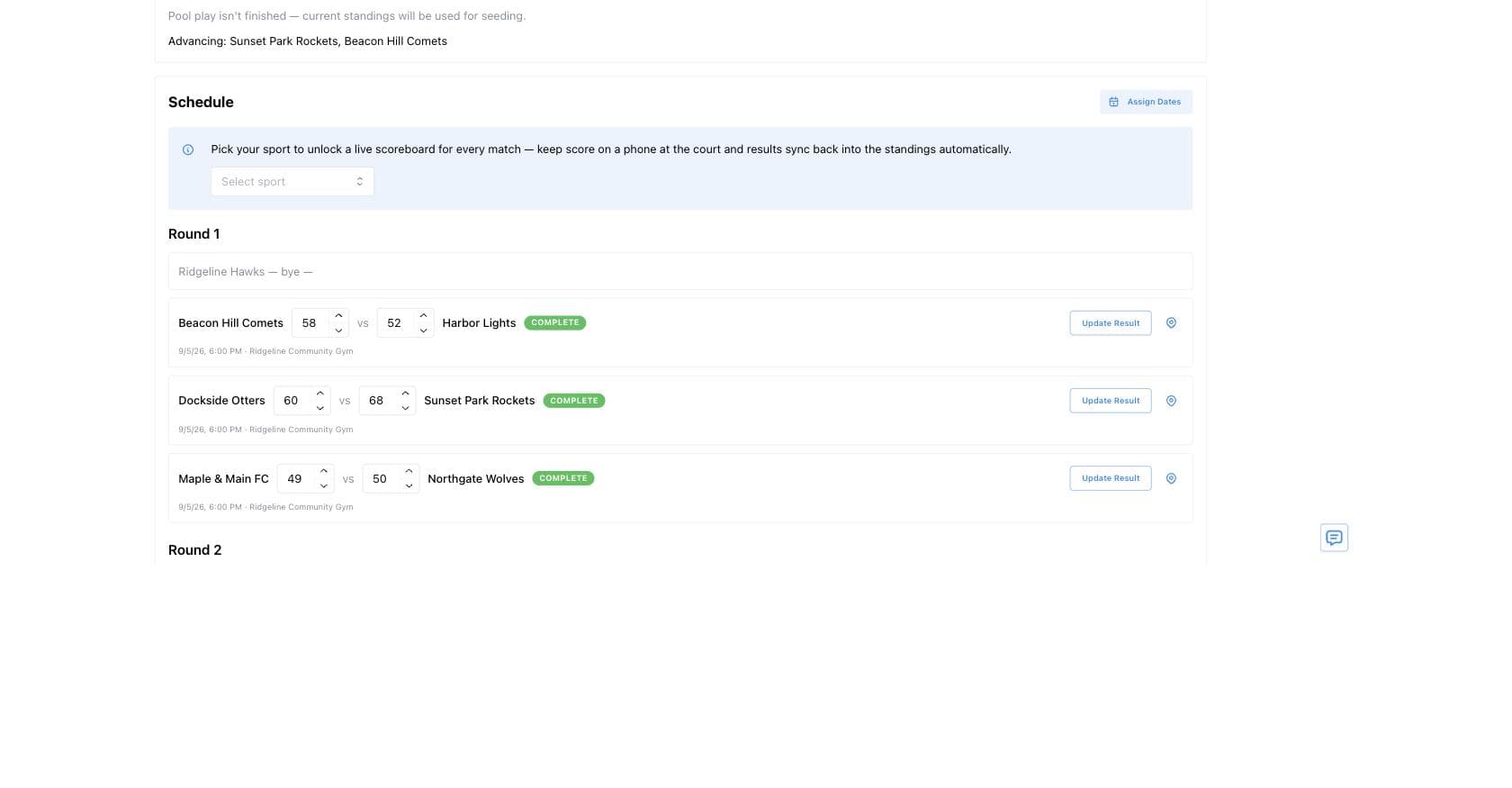
Run pickleball live
Registration, divisions, live scoreboards, and the public event hub.
See the organizer workflow →Eight-team round robin
A complete seven-round matchup table, with court and time examples.
See all 28 matches →Paper score sheets
Keep a printable backup at the scorer’s table.
Get the score sheet →Questions before you start?
Is this pickleball round robin generator free?
Yes. Generate, print, copy, and download schedules without an account. A live tournament board is set up separately; paid plans apply to larger brackets and additional organizer features.
Does this generator rotate doubles partners?
No. It supports singles and fixed doubles pairs. For doubles, enter both partners together in one team slot. Every pair stays together throughout the round robin.
How many games will each team play?
In a single round robin, each team plays every other team once: N−1 games per team and N(N−1)/2 total matches. An eight-team field has seven games per team and 28 matches. A double round robin repeats each pairing.
What happens with an odd team count?
One team sits out each round. For five teams, each team plays four games across five rounds and has one bye. The bye is not a game and does not need a court.
Can I save the schedule in Excel?
Download the CSV and open it in Excel or another spreadsheet app. It includes rounds, dates when selected, courts when assigned, and the two teams in each matchup. This is an exported snapshot, not a live scoring connection.
Can I collect registration and entry fees?
Yes. Create a live tournament and enable its registration form. Entry-fee payments are optional and organizer approval is separate from payment. The free planning tool above does not open registration automatically.
READY WHEN YOU ARE
Ready to invite your teams?
Use your plan to set up the live competition, then collect registrations and share results from one tournament hub.