
Volleyball Scoring
Volleyball scoring looks simple from the stands — first to 25 wins the set — but the mechanics underneath (rotation, side-outs, the libero) trip up a lot of first-time scorekeepers. Here's how volleyball scoring actually works, plus a full worked example.
How to Score a Volleyball Set (Step by Step)
- Start at 0-0. Note which team serves first (decided by coin toss or serve-receive choice).
- Watch each rally end. The ball becomes dead when it lands out of bounds, hits the floor in bounds, or a fault is called (net violation, foot fault, illegal hit).
- Award one point to whichever team won the rally — it doesn't matter who served.
- Check who served the point. If the serving team won, no rotation — the same server goes again. If the receiving team won, it's a side-out: rotate their lineup one position clockwise, and their new position-1 player serves next.
- Repeat steps 2-4 for every rally.
- Check for a set win after each point: has one team reached 25 (or 15 in a deciding set) with at least a 2-point lead? If yes, the set is over. If tied 24-24 (or 14-14 in a deciding set), keep playing until someone leads by 2.
- Record the set winner and reset the score to 0-0 for the next set.
- Repeat for each set until one team has won the majority needed (2 of 3, or 3 of 5).
Rally Scoring: A Point Every Rally
Modern volleyball uses rally scoring: a point is awarded on every single rally, no matter which team served.
- Serving team wins the rally → they score a point and serve again
- Receiving team wins the rally → they score a point AND take over the serve (a "side-out")
That's the entire system. There's no rally where nobody scores. Every dead ball produces a point for somebody.
This wasn't always the rule. Volleyball used side-out scoring until 1999 — only the serving team could score, so a long defensive rally by the receiving team just meant they won the right to serve, not a point. Matches with strong defense could run well over two hours. The switch to rally scoring made match length predictable, which is why every level of volleyball today — high school, college, beach, pro — uses it.
Set Formats: Best of 3 or Best of 5
How many sets you play depends on the level:
| Level | Format | Points per set |
|---|---|---|
| High school / college | Best of 5 | 25 (deciding set to 15) |
| Club / juniors | Best of 3 | 25 |
| Recreational | Best of 3 | 25 (sometimes 21) |
| Beach volleyball | Best of 3 | 21 (deciding set to 15) |
To win a set you need 25 points and a 2-point lead. There's no scoring cap — if the set is tied 24-24, play continues until one team is ahead by 2. Sets have gone to 30-28, 33-31, and beyond. The same win-by-2 rule applies to every deciding set, just at a lower target (15 points instead of 25).
The 15-Point Deciding Set
When a match reaches its final possible set (the 5th set in a best-of-5, or the 3rd in a best-of-3), the target drops to 15 points, win by 2. This keeps the decider shorter than a full set, since teams have already played 3-4 long sets by that point.
One quirk: teams switch sides of the court when the leading team reaches 8 points in the deciding set — a mid-set reset that doesn't happen in sets 1 through 4.
Rotation and Side-Out History
The rule that confuses new scorekeepers most: you don't rotate every point. You rotate only when your team wins the serve back from the opponent (a side-out).
Walk through it:
- Team A is serving and wins the rally → Team A scores, no rotation, same player serves again.
- Team B (receiving) wins the rally → Team B scores AND gets the serve. Team B's players rotate one position clockwise before the new server puts the ball in play.
So a team can score five points in a row on serve without a single rotation. The moment they lose the serve and later win it back, everyone shifts one spot.
Why side-out scoring used to matter: under the old system, only the serving team could add to the scoreboard, so a side-out was the only way for a stalled team to get back in it — it didn't add points, just possession. Rally scoring keeps the same rotation mechanic but removes the scoring restriction, which is the single biggest difference between old and new volleyball.
The Six Rotational Positions
Position 1 always serves. After a side-out, every player rotates one spot clockwise, so whoever was in position 2 moves to position 1 and becomes the new server.
Libero Tracking
The libero is a back-row defensive specialist in a contrasting jersey, and tracking them is a separate job from tracking substitutions:
- Libero replacements do not count against the team's substitution limit
- The libero can only play in the back row (positions 1, 5, 6) and cannot attack the ball above net height
- Libero swaps are recorded on a separate tracking sheet: which player they replaced, which rotation slot, and when they return
Most teams sub the libero in for a middle blocker rotating to the back row (middles are often the weakest passers), then sub them back out when that player rotates forward again. As a scorekeeper, you're just confirming the same original player returns each time — the libero exchange itself is unlimited and doesn't touch your substitution count.
Worked Example: Scoring a Set
Let's score a rally-scoring set from 0-0 to see how points and rotation interact.
| Rally | Server | Winner | How it ended | Score (A-B) | Rotation? |
|---|---|---|---|---|---|
| 1 | Team A | Team A | Ace | 1-0 | No — A still serving |
| 2 | Team A | Team B | Kill (dig, then attack) | 1-1 | Yes — side-out, B rotates |
| 3 | Team B | Team A | Block | 2-1 | Yes — side-out, A rotates |
| 4 | Team A | Team A | Ace | 3-1 | No — A still serving |
| 5 | Team A | Team A | B attack error | 4-1 | No — A still serving |
| 6 | Team A | Team A | Kill | 5-1 | No — A still serving |
| 7 | Team A | Team B | Dig + kill on the receive | 5-2 | Yes — side-out, B rotates |
Notice the score climbed to 5-1 with zero rotations for Team A across rallies 4-6, then rotated only once Team B won the point back on rally 7. That's the entire logic of rally scoring: points happen constantly, rotation happens only on a change of serve.
Play continues the same way to 25, win by 2. If the match is best of 5 and split 2-2 after four sets, the fifth set restarts at 0-0 and plays to 15, win by 2, with the mid-set side switch at 8 points.
Using a Digital Scoreboard
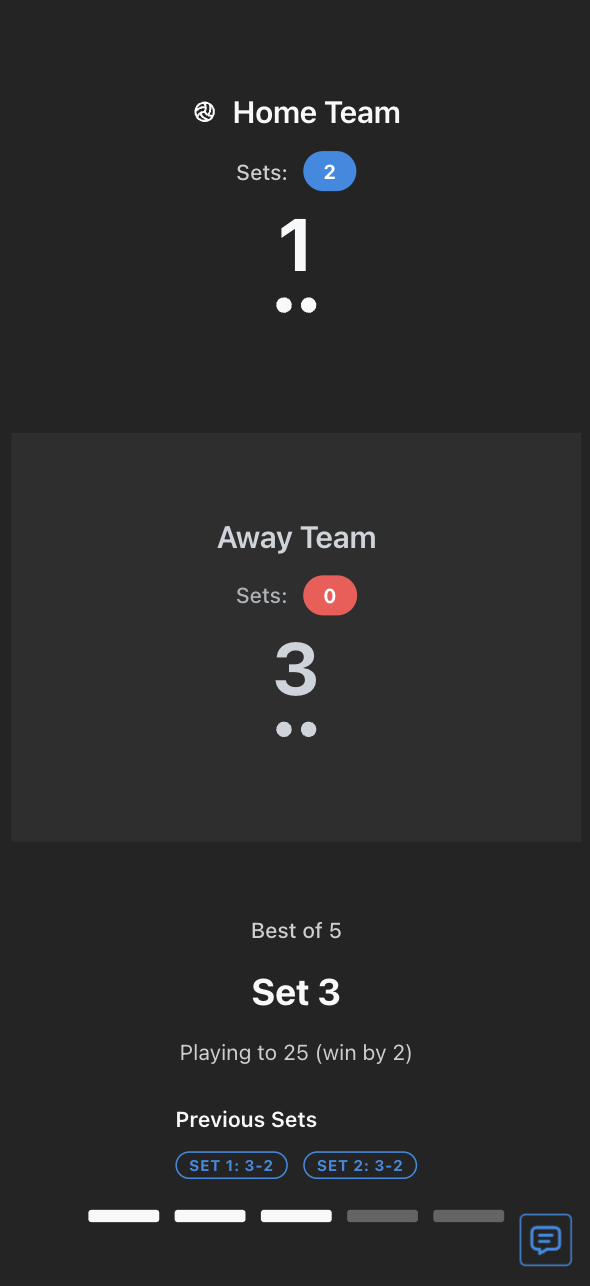
The official paper scoresheet is still required for sanctioned matches — a printable volleyball score sheet covers that. But most gyms also run a live display so players, coaches, and parents can see the score, set count, and serve from anywhere in the building.
Create a free volleyball scoreboard →
Volleyball Scoring FAQ
How does volleyball scoring work?
Volleyball uses rally scoring: a point is awarded on every rally regardless of who served. The first team to 25 points with a 2-point lead wins the set, and matches are best of 3 or best of 5 sets. The deciding set is played to 15 points, still win by 2.
How many points do you need to win a volleyball set?
25 points with at least a 2-point lead. If the set ties at 24-24, play continues past 25 until one team leads by 2 — there's no scoring cap. A deciding set (5th set in best-of-5, or 3rd in best-of-3) is played to 15 points instead of 25, same win-by-2 rule.
What's the difference between rally scoring and side-out scoring?
Rally scoring (used today) awards a point to whichever team wins the rally, no matter who served. Side-out scoring (used before 1999) only let the serving team score — winning a rally as the receiving team earned the serve, not a point. Side-out scoring made matches much longer and less predictable, which is why it was retired.
When does a volleyball team rotate?
A team rotates only when it wins the serve back from the opponent — a side-out. If a team is already serving and wins the rally, they score again with no rotation. Rotation always moves players one position clockwise, and it happens right before the new server puts the ball in play.
How does the libero affect scoring or substitutions?
The libero doesn't affect scoring directly, but libero replacements are tracked separately from regular substitutions and don't count against a team's substitution limit. The libero can only play back row and can't attack above net height, so teams typically swap them in for a middle blocker rotating to the back row and swap them back out when that player rotates forward again.
How many sets are in a volleyball match?
Most competitive levels (high school, college, club) play best of 5 sets. Recreational leagues and beach volleyball typically play best of 3. In both formats, the final possible set is the "deciding set" and is played to 15 points instead of the usual 25.
Start Keeping Score
Create a free online volleyball scoreboard → for live games, or grab the printable volleyball score sheet for the official paper record.