
Tennis Scoring Explained
Tennis has the strangest scoring system in sports. You don't count 1, 2, 3 — you count 15, 30, 40, and then something called "deuce." It looks arbitrary the first time you hear it. It isn't. Once you learn the structure — points build games, games build sets, sets build a match — the whole system clicks in about five minutes. Here's everything you need, in order.
The Tennis Court, Labeled
Before the numbers, it helps to know what part of the court you're looking at — service boxes are where the serve must land; the rest of the court is fair game once the ball is in play.
The service box you serve into alternates each point: serve to the deuce court (server's right) at the start of a game and after every even total of points, and to the ad court (server's left) after every odd total — this is where "deuce court" and "ad court" get their names, matching the deuce/advantage score situation.
The Three Layers: Points, Games, Sets
Tennis scoring is a nested structure. You win points to win a game. You win games to win a set. You win sets to win the match.
- Points: 0, 15, 30, 40, game
- Games: first to 6, win by 2 (usually)
- Sets: best of 3 (most matches) or best of 5 (men's Grand Slams)
Everything else in this guide is detail inside that structure.
Point Scoring: Love, 15, 30, 40
Each game starts at love-love (0-0). "Love" just means zero — likely borrowed from the French l'oeuf ("the egg"), since a zero looks like an egg.
Points go:
- 0 = Love
- 1st point = 15
- 2nd point = 30
- 3rd point = 40
- 4th point = Game (if you're ahead by 2)
The server's score is always called first. "15-love" means the server has 1 point and the receiver has 0. "30-40" means the server has 2 points and the receiver has 3.
The Scoring Ladder, Visualized
Why Is Tennis Scoring 15, 30, 40? A Quick History
Nobody knows for certain, but the leading theory ties tennis scoring to a medieval clock face. Points were tracked by moving a hand around a clock in quarter turns: 15, 30, 45, 60 — mirroring quarter-hours. Over centuries, "45" got shortened to "40," likely because it's faster to say and fits better against "advantage" calls. The clock theory also explains why the fourth point simply ends the game instead of being called "60" — 60 was "the hour," i.e., game over.
Whatever the true origin, the system has stuck for hundreds of years, from real tennis (jeu de paume) in French courts through to Wimbledon today.
Deuce and Advantage: What Happens at 40-40
You can't just win a game by reaching 40 — you need to win by 2 points. If both players reach 40, the score is called deuce instead of "40-40."
From deuce:
- Win the next point → you have advantage ("ad in" if you're serving, "ad out" if you're receiving)
- Win the point again while at advantage → you win the game
- Lose the point while at advantage → back to deuce
This can repeat indefinitely. A game can technically go on forever if players keep trading points at deuce — in practice, most deuce games resolve within a few extra points, but marathon games do happen.
The Deuce Loop, as a Flowchart
Example sequence:
| Score | What happened |
|---|---|
| 40-40 | Deuce |
| Ad-40 | Server wins the point — advantage server |
| 40-40 | Receiver wins the next point — back to deuce |
| 40-Ad | Receiver wins again — advantage receiver |
| Game | Receiver wins once more — game over |
Games: Winning a Set
A set is won by the first player (or team, in doubles) to win 6 games, but also by a margin of at least 2 games. So 6-0, 6-1, 6-2, 6-3, and 6-4 are all valid finished sets. 6-5 is not — the set continues.
If the score reaches 6-6, most modern tennis uses a tiebreak to decide the set (more on that below) rather than playing out an untimed game margin.
Server Alternates Every Game
Players (or doubles teams) alternate serving each full game, regardless of who's winning. Whoever serves a given game has a small scoring advantage, since serving is easier to win points on — this is part of why commentators talk about "holding serve" and "breaking serve" (winning a game you're not serving in, called a break).
The Tiebreak at 6-6
When a set reaches 6 games apiece, a tiebreak game is played to decide the set. Tiebreak scoring is completely different from regular game scoring:
- Points are counted 1, 2, 3... (not 15/30/40)
- First to 7 points, win by 2, wins the tiebreak — and the set
- If it reaches 6-6 in the tiebreak, play continues until someone leads by 2 (8-6, 9-7, 10-8, etc.)
- The set score is recorded as 7-6 for the player who won the tiebreak, regardless of the actual tiebreak score
Serving in a tiebreak follows a specific rotation: the player whose turn it is to serve starts the tiebreak by serving 1 point, then serve alternates every 2 points for the rest of the tiebreak. Players also switch ends of the court every 6 points.
The Final-Set Tiebreak Question
This is where rules vary by tournament. For the deciding set (3rd set in best-of-3, 5th set in best-of-5):
- All four Grand Slams now use a standard 7-point tiebreak at 6-6 in the final set (this was standardized across the majors starting in 2022 — before that, Wimbledon famously played advantage sets with no tiebreak until 12-12).
- Some tournaments use a 10-point match tiebreak instead of a full extra set once the final set reaches 6-6.
- Recreational and club matches often just play a standard 7-point tiebreak at 6-6 in any set, including the last one, for simplicity.
If you're watching a match and the final set seems to be dragging on past 6-6 without a tiebreak, check the tournament's specific rules — it may be one of the few competitions still playing advantage sets.
Winning the Match: Sets
Most tennis matches (women's tour, most men's tour events, mixed doubles, recreational play) are best of 3 sets — first to win 2 sets takes the match.
Men's Grand Slam singles (Australian Open, French Open, Wimbledon, US Open) are best of 5 sets — first to win 3 sets takes the match. This is why five-set men's Slam matches can run past 4 hours.
The Full Structure: Points → Games → Sets → Match
No-Ad Scoring (No-Advantage Scoring)
No-ad scoring removes the deuce/advantage cycle to speed up matches. At 40-40, instead of playing until someone wins by 2, the next point is sudden death — whoever wins it wins the game, period. The receiving side gets to choose which side of the court to receive on for that deciding point.
No-ad scoring shows up in:
- College tennis (NCAA)
- Many club and league formats
- Some doubles matches on tour
- Fast4 and other short-format events (see below)
It shortens matches meaningfully — deuce games can otherwise eat several extra minutes each.
Scoring Variants You'll Run Into
Not every match uses full best-of-3 or best-of-5 with ad scoring. A few common variants:
Pro Sets
A pro set replaces a full match with one long set, usually played to 8 games (win by 2) instead of the standard 6. Common in college tennis and some tournament qualifying rounds where court time is limited. A tiebreak at 8-8 is typical.
Fast4
Fast4 is a short format designed for TV and casual play:
- Sets played to 4 games (win by 2) instead of 6
- No-ad scoring on every deuce
- Tiebreak at 3-3 instead of 6-6
- Best of 3 sets (so a whole match can finish quickly)
Match Tiebreaks (Champions Tiebreak)
Instead of playing a full third set, some formats (common in doubles, including on the pro tour) replace the deciding set entirely with a single 10-point tiebreak (first to 10, win by 2). It's faster and still gives a deciding-set feel without another 30+ minutes of play.
How to Keep Score at a Kid's Match: A Step-by-Step Guide for Parents
If you're on the sideline at a junior match with zero tennis background, here's exactly what to do, in order:
- Bring paper, or open a scoreboard app before the first point. Write (or set) both players' names.
- Watch who serves first. That player is the "server" for game 1 — write their score first, always, for this entire game.
- After every point, say the score out loud in your head: server's score, then receiver's score ("love-love," then "15-love," etc.). This forces you to actually track it instead of guessing later.
- When both reach 40, say "deuce" instead of "40-40." Watch for who wins the next point — that's "advantage" to them. If they win the point after that too, the game is over.
- Mark a tally for the game winner, then reset points to love-love for the next game. Don't carry point scores between games — only the game count carries forward.
- Every second game, remember the server changes to the other player. If you lose track of whose serve it is, count total games played — odd-numbered games starting means Player A serves, even means Player B (or vice versa from wherever they started).
- When someone reaches 6 games with a 2-game lead, that set is over. Mark it down (e.g., "6-4") and start the next set's game count back at 0-0.
- If a set reaches 6-6, expect a tiebreak — the counting style changes to 1, 2, 3 for that one game only, and the set gets recorded as 7-6 once it's done.
- Track sets won, not just games. The player who wins 2 sets (or 3, in best-of-5) wins the whole match — everything else resets along the way.
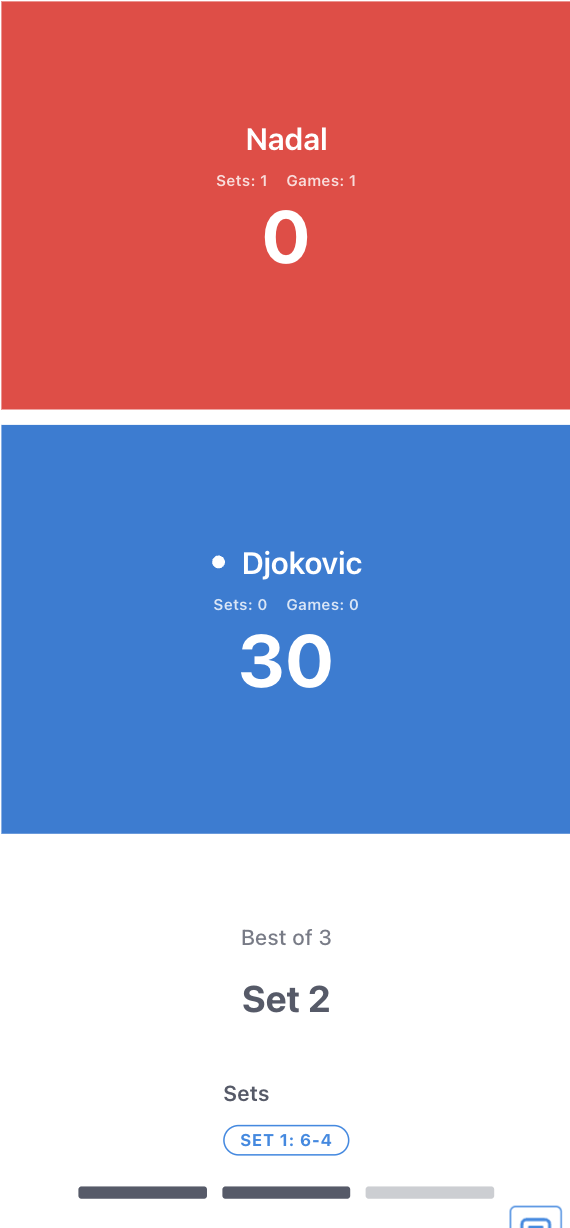
If you'd rather not hold all of this in your head while also cheering, a digital scoreboard removes the guesswork — it tracks points, games, sets, and server rotation automatically, and displays big enough to read from the fence. Try a free tennis scoreboard →
Worked Example: A Full Game, Then a Full Set
Point by Point: One Game
Here's a complete game, server (Player A) eventually winning, shown as the scoreboard would actually display after each point:
| Point # | Winner | Scoreboard Reads |
|---|---|---|
| Start | — | Love – Love |
| 1 | A | 15 – Love |
| 2 | B | 15 – 15 |
| 3 | B | 15 – 30 |
| 4 | A | 30 – 30 |
| 5 | A | 40 – 30 |
| 6 | B | Deuce |
| 7 | A | Advantage A |
| 8 | B | Deuce |
| 9 | A | Advantage A |
| 10 | A | Game A |
That's a full game — 10 points played, with a deuce battle in the middle, which is a completely normal length for a competitive game.
Game by Game: One Full Set
Now zoom out one level. Here's how a set's running game score builds, ending in a tiebreak:
| Game # | Server | Winner | Running Set Score |
|---|---|---|---|
| 1 | A | A | 1 – 0 |
| 2 | B | A | 2 – 0 |
| 3 | A | B | 2 – 1 |
| 4 | B | B | 2 – 2 |
| 5 | A | A | 3 – 2 |
| 6 | B | B | 3 – 3 |
| 7 | A | A | 4 – 3 |
| 8 | B | B | 4 – 4 |
| 9 | A | A | 5 – 4 |
| 10 | B | B | 5 – 5 |
| 11 | A | A | 6 – 5 |
| 12 | B | B | 6 – 6 → Tiebreak |
At 6-6, the tiebreak kicks in. Say Player A wins it 7-5 — the set gets recorded as 7-6(5), where the "(5)" is the loser's tiebreak point total, a common scorecard convention so you can see how close the tiebreak was.
A full match score is written set by set, with the winner of each set's game count listed first. For example, 6-4, 3-6, 7-6(5) reads as: Player A won the first set 6-4, lost the second set 3-6, then won the third set (and the match) 7-6 on a tiebreak that finished 7-5.
Digital Scorekeeping for Tennis
Paper and mental math work fine for casual hitting, but scoring gets genuinely hard to track live once deuce, ad points, and tiebreaks stack up — especially if you're also trying to coach, film, or just watch the match. A live digital scoreboard handles the point-to-game-to-set logic for you and displays it big enough for spectators to follow from the fence.
Create a free tennis scoreboard →
If you also play or coach pickleball, the scoring logic is a useful contrast — pickleball uses side-outs and rally counts instead of 15/30/40. Our pickleball scoring guide breaks down that system, and you can compare it directly against a pickleball scoreboard side by side with the tennis version.
Tennis Scoring FAQ
Why is tennis scoring 15, 30, 40?
The most widely accepted theory traces it to a medieval clock face, where points were tracked in quarter-hour increments: 15, 30, 45, 60. Over time "45" was shortened to "40," and "60" became simply winning the game. No one has definitive proof of the origin, but the clock theory is the standard explanation historians point to.
What is deuce in tennis?
Deuce is the score when both players have won 3 points in a game (40-40). Because a game must be won by a margin of 2 points, deuce triggers a mini-battle: whoever wins the next point gets "advantage," and if they win the point after that too, they win the game. If they lose it instead, the score returns to deuce.
How does a tennis tiebreak work?
When a set reaches 6 games apiece, players switch to counting points 1, 2, 3 instead of 15/30/40. First to 7 points, win by 2, wins the tiebreak and the set 7-6. If the tiebreak reaches 6-6, play continues until someone leads by 2. Serve rotates every 2 points during the tiebreak.
What is no-ad scoring in tennis?
No-ad (no-advantage) scoring skips the deuce/advantage cycle. At 40-40, the next point is sudden death — whoever wins it wins the game outright, with the receiver choosing which side to receive on. It's common in college tennis, club leagues, and short-format events to keep match length predictable.
How many sets do you need to win a tennis match?
Most matches are best of 3 sets, so winning 2 sets wins the match. Men's Grand Slam singles matches (Australian Open, French Open, Wimbledon, US Open) are best of 5 sets, requiring 3 set wins. Nearly all other professional and recreational matches, including women's tour events and doubles, are best of 3.
What happens if a set reaches 6-6?
In almost all modern tennis, a 7-point tiebreak decides the set once it reaches 6 games apiece. The set is recorded as 7-6 for the tiebreak winner. A small number of tournaments and formats still play advantage sets (no tiebreak, win by 2 games) in the deciding set, though this has become rare since the Grand Slams standardized final-set tiebreaks.
Does the score reset every game?
Yes. Point scores (love, 15, 30, 40) reset to love-love at the start of every new game. Only the game count carries forward within a set, and only the set count carries forward within a match.
Score Your Next Match
Skip the mental math on deuce, ad points, and tiebreaks — let a scoreboard track it live.
Start a free tennis scoreboard →
Want to compare formats before your next pickup game? See how tennis and pickleball scoring stack up side by side with our pickleball scoreboard.