
How to Keep Score in Pickleball
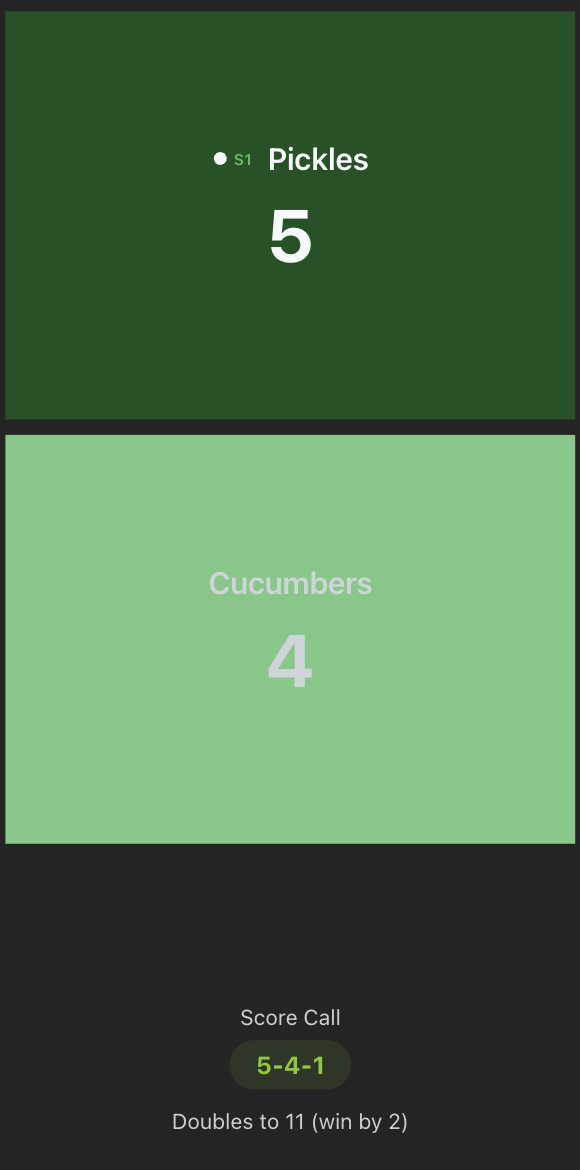
Keeping score in pickleball means tracking points that only the serving team can win, called out as a three-number sequence: serving score, receiving score, and server number. Pickleball scoring confuses almost everyone at first. The three-number score call, the server switching, the mysterious "0-0-2" start—it all seems overcomplicated until it clicks. This guide will make it click.
The Basics: Only Servers Score
The most important rule in pickleball:
Only the serving team can score points.
If the receiving team wins the rally, they don't get a point—they get the serve. This is called a side-out.
This is why games can take a while. You might win 5 rallies in a row, but if you were receiving, you scored zero points during those rallies.
Doubles Scoring: The Three-Number Call
In doubles, the score has three numbers:
Server's Score – Receiver's Score – Server Number
Example: "4-2-1" means:
- Serving team has 4 points
- Receiving team has 2 points
- Server 1 is serving
Server 1 and Server 2
Each team has two players, and they're designated as Server 1 and Server 2.
- Server 1 serves first when their team gets the ball
- If Server 1's team loses the rally, Server 2 serves next
- If Server 2's team loses the rally, it's a side-out and the other team serves
Think of it as: each team gets two chances (two servers) before giving up the ball.
The Weird "0-0-2" Start
At the very beginning of the game, the starting team only gets ONE server, not two.
That's why games start "0-0-2" (or "0-0-start" in casual play):
- Serving team: 0 points
- Receiving team: 0 points
- Server 2 is serving (only one serve chance)
Why? To offset the advantage of serving first. If the first team got both servers, they'd have a big early advantage.
The Score Call Sequence
Before every serve, call the score out loud:
- Your team's score (serving team)
- Opponent's score (receiving team)
- Which server you are (1 or 2)
Examples:
- "3-5-1" = We have 3, they have 5, I'm server 1
- "7-7-2" = We have 7, they have 7, I'm server 2
- "10-9-1" = Game point! We have 10, they have 9, I'm server 1
Singles Scoring: Two Numbers Only
Singles is simpler—no server number needed.
Just call: Server's Score – Receiver's Score
Example: "6-4" means server has 6, receiver has 4.
Singles Court Position Rule
In singles, your score determines which side you serve from:
- Even score (0, 2, 4, 6...) → Serve from the right side
- Odd score (1, 3, 5, 7...) → Serve from the left side
This means you'll alternate sides as you score, making singles a workout.
Winning the Game
Standard games are played to 11 points, win by 2.
- At 10-10, play continues until someone leads by 2
- Tournament games might be to 15 or 21
Switching Sides
In tournament play, teams switch sides:
- When the first team reaches 6 points (in a game to 11)
- When the first team reaches 8 points (in a game to 15)
Common Scoring Mistakes
Mistake 1: Forgetting the Server Number
- Wrong: "5-3" (in doubles)
- Right: "5-3-2"
Mistake 2: Calling Your Score Second
- Wrong: "3-7-1" when you're losing 7-3
- Right: Server's score always comes first
Mistake 3: Wrong Position After Scoring
When your team scores, you switch positions with your partner. The server moves to the other side and serves again.
Mistake 4: Starting with "0-0-1"
- Wrong: Starting the game 0-0-1
- Right: Starting the game 0-0-2
Position Rules When Scoring
This is where people get tripped up:
When Your Team Scores (You're Serving)
- You (the server) switch sides with your partner
- You serve again from the new side
- Server number stays the same
When You Lose the Rally as Server 1
- You stay where you are
- Your partner becomes Server 2
- Your partner serves from wherever they are
When You Lose the Rally as Server 2
- Side-out: other team gets the ball
- They start with their Server 1
Quick Reference: Where Do I Stand?
At the start of each new service turn (after a side-out), players should be in their "correct" positions:
- Server 1 starts on the right side
- When the score is even, Server 1 should be on the right
- When the score is odd, Server 1 should be on the left
If Server 1 is on the wrong side based on the score, someone's position got messed up earlier in the game.
Using a Digital Scoreboard
Paper scoring works, but a digital scoreboard helps:
- No verbal disputes — Everyone can see the score
- Tracks server number — App handles the 1/2 logic
- Share with spectators — People watching can follow along
Create a free pickleball scoreboard →
Rally Scoring (New Alternative)
Some recreational groups use rally scoring where every rally awards a point to the winning team, regardless of who served.
- Games go faster
- Easier for beginners
- Not official rules (yet)
- Some tournaments experimenting with it
If using rally scoring, you only need two numbers (your score, their score).
Practice Exercise
Try calling these scores out loud:
-
Your team has 5, opponents have 7, you're server 2
- Answer: "5-7-2"
-
Your team has 0, opponents have 0, game just started
- Answer: "0-0-2"
-
Your team has 9, opponents have 10, you're server 1
- Answer: "9-10-1"
-
Singles: You have 8, opponent has 6
- Answer: "8-6" (serve from right side since 8 is even)
Pickleball Scoring FAQ
How do you call the score in pickleball?
Call the score in three numbers: serving team's score, receiving team's score, and the server number (1 or 2). For example, "5-3-2" means the serving team has 5 points, the receiving team has 3, and the second player on the serving team is serving. Singles uses just two numbers (no server number).
How many points to win pickleball?
Standard pickleball games go to 11 points, win by 2. Tournament games are often played to 15 or 21, also win by 2. Only the serving team can score points in traditional scoring; rally scoring (used in some leagues) awards a point on every rally.
What is the 0-0-2 start in pickleball?
The 0-0-2 rule means the team starting the game gets only one server before side-out. The "2" indicates that the starting server is treated as the second server — if they lose the rally, the serve goes to the other team immediately rather than rotating to a partner. After the first side-out, normal serving rules apply for both teams.
What is a side-out in pickleball?
A side-out is when the serve switches from one team to the other. In doubles, a side-out happens after both players on the serving team have served and lost a rally (the 0-0-2 start is the only exception). In singles, the serve switches every time the receiving team wins a rally.
Can the receiving team score in pickleball?
In traditional pickleball scoring, no — only the serving team can score points. Winning a rally as the receiver earns the serve, not a point. Rally scoring (an alternative format used in some leagues) lets either team score on every rally.
How is pickleball doubles scored differently than singles?
Doubles uses a three-number score with a server number (1 or 2), since both partners can serve before a side-out. Singles uses just two numbers (server-receiver). Singles also uses serving position (right side for even scores, left for odd) instead of server numbers.
Use a free pickleball scoreboard online →
Start Your Game
Now that you know the rules, keep score easily with a free digital scoreboard:
Create Free Pickleball Scoreboard →
Prefer paper for league night? Grab a free printable pickleball score sheet.
Running a tournament? Set up a bracket to track all your matches.