
How Is Softball Scored?
Softball scoring runs on the same core idea as baseball — cross home plate, score a run — but the game structure (fewer innings, the mercy rule, fastpitch vs. slowpitch differences) changes how a game plays out and how a scorekeeper tracks it. Here's how softball scoring actually works.
How Runs Are Scored
A team scores 1 run every time a batter or baserunner safely touches all four bases in order — first, second, third, then home plate — without being put out along the way.
Common ways a run scores:
- Hit — the batter reaches base safely and later comes around to score on subsequent plays
- Home run — the batter hits the ball out of the field of play (or, depending on the field, in-the-park) and rounds all bases untouched by a fielder
- Walk with bases loaded — if the bases are loaded and the batter draws a walk (4 balls), the runner on third is forced home
- Sacrifice fly — a runner on third tags up and scores after a fly ball is caught
- Error or wild pitch/passed ball — a runner advances home due to a fielding mistake
There's no partial credit — a runner either scores the run or doesn't. There's also no limit on how many runs can score on a single play (a bases-loaded home run scores 4 runs at once).
How a Game Is Won
Softball is played over 7 innings at most competitive levels (high school, college, most adult leagues), compared to baseball's 9. Recreational and youth leagues often play fewer — 5 or 6 innings is common.
Each inning has a top half (visiting team bats) and bottom half (home team bats). Each half-inning ends after the batting team records 3 outs. Whichever team has scored more total runs after all innings are complete wins. If the home team is already ahead after the visiting team's final at-bat, the bottom of the last inning isn't played — the game ends immediately.
The Mercy Rule (Run Rule)
Softball games can end early if one team builds a large enough lead — usually called the "mercy rule" or "run rule." Typical thresholds (these vary by league and level, so always check local rules):
| Lead | Ends after |
|---|---|
| 15+ runs | 3rd inning |
| 10+ runs | 5th inning |
| 8+ runs | 7th inning (some leagues) |
If a team is ahead by the threshold amount at the end of that inning (or the trailing team's turn at bat in that inning), the game is called immediately as a win for the leading team.
Extra Innings
If the score is tied after regulation innings, play continues into extra innings. Many fastpitch leagues use a tiebreaker rule (sometimes called international tiebreaker or "flip flop" rule) starting in extra innings: each half-inning begins with a runner already placed on second base, to speed up scoring and shorten games. Slowpitch leagues often use the same or a similar rule; check the specific league's format.
Fastpitch vs. Slowpitch: What Changes Scoring
The two main softball formats don't change how runs are counted, but they change how often scoring opportunities happen:
- Fastpitch — pitcher throws underhand at high speed, strikeouts and stolen bases are common, games tend to be lower-scoring and pitcher-driven
- Slowpitch — pitch must arc on its way to the plate, no stealing bases (in most leagues), bigger bats and softer pitching lead to more contact and generally higher-scoring games
A scorekeeper tracks runs the same way in both — the format affects the pace and volume of scoring, not the scoring rules themselves.
Common Scoring Situations Worth Knowing
A few plays come up often enough that they're worth flagging separately on a scoresheet:
- Error-driven runs — if a run scores because of a fielding error rather than a clean hit, official scorekeeping still counts the run for the team, but the batter and fielder's individual stat lines are affected differently (this matters for stats, not for the team score itself).
- Run batted in (RBI) — credited to the batter whose plate appearance directly caused a run to score (a hit, sacrifice fly, or bases-loaded walk). It's a separate stat from the run itself, which is credited to the runner who crossed the plate.
- Unearned runs — runs that score because of an error or passed ball are marked "unearned" in a pitcher's individual stats, but they still count exactly the same toward the team's total on the scoreboard.
None of these change the final score — they're bookkeeping details that matter for individual stats, not for who's ahead on the board.
How to Keep Score with a Scorebook
A softball scorebook tracks every batter's plate appearance per inning using a small diamond diagram, marking how far they advanced and how they were put out (if at all).
| Inning | Batter | Result | Runs scored this at-bat | Running score (Home-Away) |
|---|---|---|---|---|
| 1 | #4 Smith | Single, later scores on a double | 1 | 1-0 |
| 1 | #7 Lee | Double, drives in Smith | 0 | 1-0 |
| 2 | #2 Diaz | Groundout, no runners advance | 0 | 1-0 |
| 3 | #9 Park | Home run | 1 | 2-0 |
| 4 | #4 Smith | Walk with bases loaded | 1 | 3-0 |
Each row records the batter, what happened, whether a run scored on that specific play, and the updated total — the same running-tally approach used across most bat-and-ball sports.
Using a Digital Scoreboard
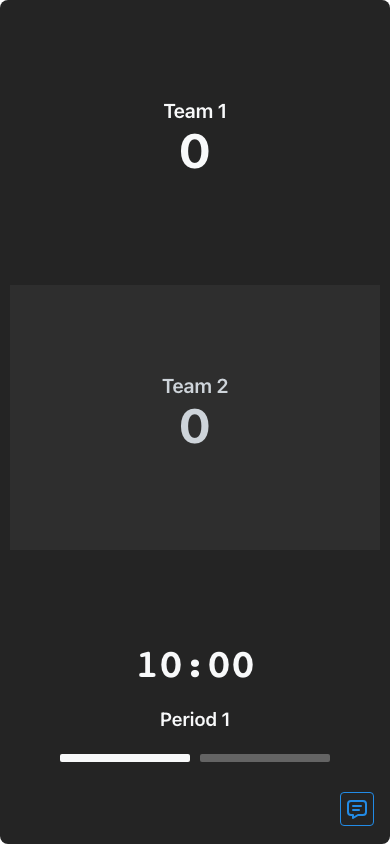
The official scorebook remains the record for stats and disputes, but a live display keeps the score, inning, and outs visible to the whole field. Create a free online softball scoreboard →
Softball Scoring FAQ
How many runs is a home run worth?
A home run always scores 1 run for the batter, plus 1 run for every runner already on base. A bases-loaded home run scores 4 runs on a single play — the batter and all three baserunners.
How many innings are in a softball game?
Most competitive levels (high school, college, adult league) play 7 innings, compared to baseball's 9. Youth and recreational leagues frequently play fewer, often 5 or 6, depending on the league's rules.
What is the mercy rule in softball?
The mercy rule (or run rule) ends a game early if one team's lead is large enough — commonly 15 runs after 3 innings, 10 runs after 5, or 8 runs after 7, though exact numbers vary by league. It's meant to keep lopsided games from dragging on.
How does extra innings work in softball?
If the score is tied after regulation, the game continues into extra innings. Many leagues use a tiebreaker rule where each half-inning starts with a runner already on second base, which increases scoring chances and shortens extra-inning games compared to starting each inning with the bases empty.
What's the scoring difference between fastpitch and slowpitch softball?
None — both formats score runs the same way (touch all four bases safely). The difference is pace: fastpitch tends to be lower-scoring due to faster pitching and strikeouts, while slowpitch tends to be higher-scoring due to arced pitches and more contact hitting.
Can a team score more than one run on a single play?
Yes. Every runner who crosses home plate on a single play scores a run, and there's no cap — a bases-loaded double or home run can score multiple runs at once.
Does the visiting team always bat first?
Yes. The visiting team bats in the top of every inning, and the home team bats in the bottom. If the home team is already leading after the visiting team's final at-bat, the home team doesn't need to bat again and the game ends immediately.
Start Keeping Score
Create a free online softball scoreboard → for live games, whether you're running the scorebook or just need a display everyone can see.