
How Is Shuffleboard Scored?
"Shuffleboard" actually covers two different games with two different scoring systems — table shuffleboard (the bar/rec-room game with weighted pucks and sand-dusted boards) and outdoor or deck shuffleboard (the court game played with cues and discs, common on cruise ships and in retirement communities). Here's how scoring works for both.
Table Shuffleboard: Scoring by the Board
Table shuffleboard is played on a long, narrow, sand-coated board. Players slide weighted pucks (called "weights") down the board toward the far end, trying to land in scoring zones without sliding off.
Scoring zones, from nearest to farthest:
| Zone | Points |
|---|---|
| 1 (closest) | 1 |
| 2 | 2 |
| 3 | 3 |
| 4 (farthest, "the hanger") | 4 |
| Off the board / in the gutter | 0 |
Each player or team slides 4 weights per round (called a "frame"). After all weights are thrown, only the leading color scores — you compare your best-placed weight to your opponent's best-placed weight, and only weights that are farther down the board than your opponent's best weight count. This is the part that trips up new scorekeepers: it's not "add up everyone's zone values." It's closer to bowling's frame-by-frame elimination, where you only count what beats the other side's closest weight.
A simplified way to score for casual/bar play: award points equal to the zone value for every weight of the leading color that's positioned farther than the opponent's best weight. Weights hanging off the edge without falling (in the "hangout" zone) typically score double their zone value in many house rules — always confirm this with house rules before play, since it varies by venue.
Games are usually played to 15 or 21 points, straight scoring, win by any margin (no win-by-2 requirement in most casual formats).
Outdoor/Deck Shuffleboard: The 10-Off Scoring Triangle
Outdoor shuffleboard (also called deck shuffleboard) uses a large painted court and cues to push discs into a triangular scoring zone at the far end.
| Zone | Points |
|---|---|
| 10-off (top of the triangle, past the "10-off" line) | 10, minus 10 (net zero — see below) |
| 8 | 8 |
| 7 | 7 |
| 10 (bottom of the triangle) | 10 |
| Off the court | 0 |
The quirky part: the "10-off" zone at the tip of the triangle is worth 10 points, but only if none of your discs are also sitting anywhere else in a negative or off-target position — many rulesets actually subtract 10 points if a disc is knocked into that zone under certain house variations, which is where the name comes from. Because deck shuffleboard rules vary significantly by club (this is a game with strong regional and club-specific house rules), always confirm the exact triangle values and 10-off condition with whoever runs the court before scoring a real match.
Standard match play: 8 discs per frame (4 per player/team, alternating turns), scored after all discs are played, then reset for the next frame. Games are commonly played to 50 or 75 points.
Cutthroat, Singles, and Doubles
Both versions of shuffleboard can be played:
- Singles — one player per side
- Doubles — two players per side, alternating who shoots
- Cutthroat (table shuffleboard) — three players, each for themselves, with the two trailing players' scores sometimes combined against the leader depending on house rules
The scoring mechanics (compare-and-count for table, triangle zones for deck) stay the same regardless of format — only the number of players sliding changes.
Common Fouls That Affect Scoring
A few situations come up often enough that every scorekeeper should know how they're handled:
- A weight or disc that lands on a line between two zones — house rules vary, but the common resolution is to score the lower of the two adjacent zones, or void the shot entirely if the disc is more than halfway on the line. Confirm this before the match starts, since it's one of the most commonly disputed calls.
- Knocking an opponent's piece out of a scoring zone — this is legal and part of the strategy in both versions of the game. If your weight knocks an opponent's weight out of the 4-zone and comes to rest there itself, you get the points, not them.
- A piece that goes off the end of the board or court — scores zero and is typically removed from play before the frame is tallied, so it can't be knocked back into scoring position later in the frame.
- Foot faults (deck shuffleboard) — stepping over the baseline while releasing a disc can void that shot in more formal or tournament play, though it's rarely enforced in casual games.
Equipment Note for Table Shuffleboard
Table shuffleboard boards need regular maintenance with silicone-based shuffleboard sand (sometimes called wax) to keep the weights sliding smoothly and predictably. A board with too little sand plays "sticky" and weights fall short; too much and shots slide long and unpredictably. This doesn't change the scoring rules, but it's worth knowing as a scorekeeper because inconsistent board conditions are the most common excuse for a disputed frame — and also why serious players bring their own sand to tournaments.
How to Keep Score by Hand
A shuffleboard scoresheet just needs the frame number, each side's zone tally for that frame, and a running total.
| Frame | Team A (zone points) | Team B (zone points) | Running score (A-B) |
|---|---|---|---|
| 1 | 3 | 0 | 3-0 |
| 2 | 0 | 4 | 3-4 |
| 3 | 2 | 0 | 5-4 |
| 4 | 0 | 1 | 5-5 |
| 5 | 4 | 0 | 9-5 |
Write the frame's points for the leading side only (the other side scores 0 that frame, since only one side scores per frame in the standard compare-and-count method) and keep a running total until someone reaches the target score.
Using a Digital Scoreboard
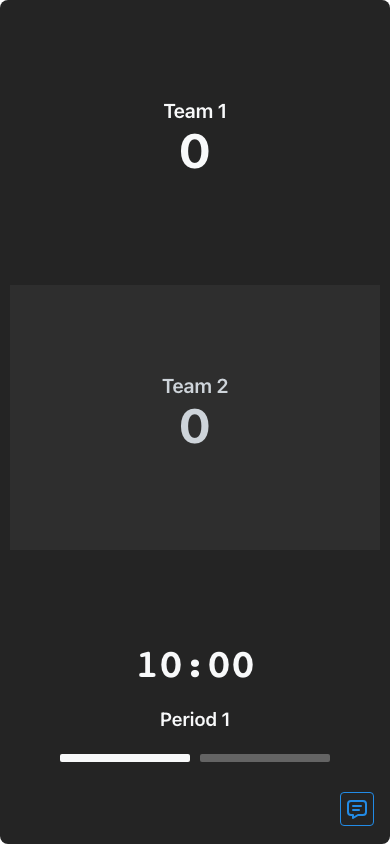
For casual games and tournaments, a live scoreboard keeps the running total visible to everyone at the table or court without recounting zones each frame. Create a free online scoreboard →
Shuffleboard Scoring FAQ
How do you score in table shuffleboard?
After both players or teams slide their weights, only the leading color scores — count the zone value of each of their weights that's positioned farther down the board than the opponent's best weight. The trailing side scores 0 for that frame. Games are typically played to 15 or 21 points.
What is the 10-off zone in outdoor shuffleboard?
It's the triangular scoring zone farthest from the shooter on a deck/outdoor shuffleboard court. In many rulesets it's worth 10 points, but some house rules apply a penalty condition tied to the "10-off" name — rules vary enough by club that it's worth confirming locally before a real match.
How many points do you need to win a shuffleboard game?
It depends on the format: table shuffleboard is commonly played to 15 or 21 points, while outdoor/deck shuffleboard matches often go to 50 or 75 points. Neither format typically requires a win-by-2 margin in casual play.
Do all of a player's shuffleboard pucks count for score?
No. In the standard compare-and-count method, only the pucks or weights that are farther down the board than the opponent's closest scoring piece count — everything behind that gets zero for the frame.
Is table shuffleboard the same game as outdoor shuffleboard?
No — they share a name and a sliding mechanic, but table shuffleboard uses a sand-dusted board and numbered zones (1-4), while outdoor/deck shuffleboard uses cues, discs, and a triangular scoring zone with different point values. Scoring rules are not interchangeable between the two.
What happens if a puck or disc goes off the board or court?
It scores zero points and is removed before tallying — it doesn't block or affect the opponent's discs the way an in-bounds piece might.
Start Keeping Score
Create a free online scoreboard → to track shuffleboard frames and running totals for your next game or tournament.