
How Is Rugby Scored?
"Rugby" actually refers to two separate sports with different rules and, importantly, different point values: rugby union (15 players per side, more common globally and in the Rugby World Cup) and rugby league (13 players per side, dominant in Australia and parts of the UK). Here's how scoring works in each.
Rugby Union Scoring
| Score | Points | How it happens |
|---|---|---|
| Try | 5 | Grounding the ball in the opponent's in-goal area (like a touchdown, but the ball must be pressed to the ground, not just carried across the line) |
| Conversion | 2 | After a try, a place kick through the goalposts, taken from a spot in line with where the try was scored |
| Penalty kick | 3 | A kick at goal awarded after the opposing team commits certain infringements |
| Drop goal | 3 | Kicking the ball through the goalposts during open play, dropping it onto the ground and kicking it on the half-volley |
A try is the headline score, but note that a converted try is worth 7 total (5 + 2) — commentators and scoresheets often talk in terms of "how many tries" a team needs because of that combined value.
How a Match Is Won
A rugby union match is 80 minutes, split into two 40-minute halves. Whichever team has more points when time expires wins. If the score is tied, most competitions allow a draw in league play; knockout/playoff matches typically go to extra time and then, if still tied, a kicking competition or sudden-death rules specific to that tournament.
Rugby League Scoring
Rugby league shares the same basic vocabulary as union but with different point values and a different try requirement.
| Score | Points | How it happens |
|---|---|---|
| Try | 4 | Grounding the ball in the opponent's in-goal area |
| Conversion | 2 | Place kick through the posts after a try |
| Penalty goal | 2 | A kick at goal after certain infringements |
| Drop goal (field goal) | 1 | Kicking the ball through the posts during open play |
The most important structural difference from union: rugby league uses a six-tackle rule — the attacking team gets six tackles to advance and score before possession turns over, similar in spirit to downs in American football. This doesn't change the point values, but it changes how possessions (and therefore scoring chances) happen.
How a Match Is Won
Also 80 minutes across two 40-minute halves. Higher total score wins. Draws are allowed in regular league play in most competitions; finals/knockout matches use extra time or golden-point sudden death rules specific to the competition.
The Biggest Scoring Differences Between the Two Codes
| Difference | Rugby union | Rugby league |
|---|---|---|
| Try value | 5 | 4 |
| Penalty kick value | 3 | 2 |
| Drop goal value | 3 | 1 |
| Players per side | 15 | 13 |
| Possession rule | No tackle limit — play continues via rucks/mauls | Six-tackle limit per possession |
If you're scorekeeping and unsure which code is being played, check the try value first — union tries are worth 5, league tries are worth 4. That single number tells you which rulebook to use for the rest of the scoring.
Bonus Points in League Tables
Match scoring (tries, conversions, kicks) is what happens on the field, but many rugby competitions — in both codes — also award bonus points in the standings that don't appear on the in-game scoreboard at all:
- Try-scoring bonus point — awarded to a team that scores 4 or more tries in a match, win or lose, in many union competitions
- Losing bonus point — awarded to a team that loses by 7 points or fewer (union) or a similarly close margin (varies by league), to reward a competitive performance
These are standings points, not game points — they never affect the actual final score of the match itself, only where a team sits in a league table over a season. A scorekeeper running a live match display only needs the in-game point values (try, conversion, penalty, drop goal); bonus points are calculated separately after the result is final.
How to Keep Score by Hand
A rugby scoresheet tracks each scoring play, which team it belongs to, and the point value, the same way as football or basketball.
| Half | Team | Play | Points | Running score (Home-Away) |
|---|---|---|---|---|
| 1st | Home | Try | 5 | 5-0 |
| 1st | Home | Conversion | 2 | 7-0 |
| 1st | Away | Penalty kick | 3 | 7-3 |
| 2nd | Away | Try | 5 | 7-8 |
| 2nd | Away | Conversion (missed) | 0 | 7-8 |
| 2nd | Home | Drop goal | 3 | 10-8 |
Note conversions and penalty attempts that are missed still get logged (as 0 points) so the sheet reflects every scoring opportunity, not just the successful ones.
Using a Digital Scoreboard
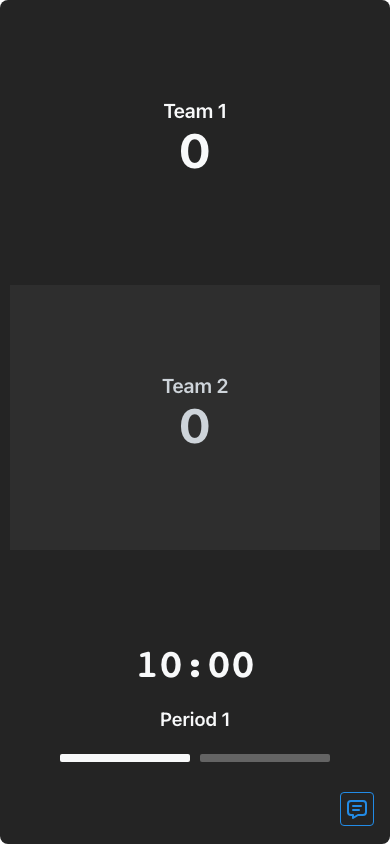
A live scoreboard helps the sideline, clubhouse, or stream follow the score without needing to track tries, conversions, and penalties in their head. Create a free online scoreboard →
Rugby Scoring FAQ
How many points is a try worth?
It depends on the code. In rugby union, a try is worth 5 points. In rugby league, a try is worth 4 points. Both codes then allow a conversion kick attempt worth an additional 2 points.
What's the difference between a conversion and a penalty kick?
A conversion follows a try and is worth 2 points in both codes. A penalty kick is awarded for an opposing infringement and can be taken at any point during play — worth 3 points in union, 2 points in league.
How many points is a drop goal worth?
In rugby union, a drop goal is worth 3 points. In rugby league, the equivalent (usually called a field goal) is worth just 1 point. It's the biggest single point-value gap between the two codes.
What's the difference between rugby union and rugby league?
They're related but separate sports with different rules. Union has 15 players per side and no limit on how many tackles a team can have before losing possession. League has 13 players per side and a six-tackle rule, after which possession changes over if the attacking team hasn't scored. Point values for tries, conversions, penalties, and drop goals also differ between the two.
How long is a rugby match?
Both codes play 80 minutes, split into two 40-minute halves, with a break at halftime.
Can a rugby match end in a tie?
Yes, in regular season/league play for both codes, a tied score at full time typically stands as a draw. Knockout and finals matches use extra time and, if still tied, sudden-death or kicking competition rules specific to that tournament.
Which is worth more, a converted try or two penalty kicks?
In rugby union, a converted try is worth 7 points (5 + 2), which is more than two penalty kicks (3 + 3 = 6). In rugby league, a converted try is worth 6 points (4 + 2), exactly matching three penalty goals (2 + 2 + 2) or beating two (2 + 2 = 4).
What are bonus points in rugby?
Bonus points are extra standings points awarded in many league competitions — separate from the match score — for scoring several tries in a game or for losing by a narrow margin. They affect a team's position in the season table, not the final score of the match itself, so they don't show up on a live scoreboard.
Start Keeping Score
Create a free online scoreboard → to track tries, conversions, and penalties for either code, live on the sideline or on stream.