
How Is Football Scored?
Football scoring looks simple on a scoreboard — just a running total — but it's built from five different ways to put points on the board, each worth a different amount. Here's how football scoring actually works, plus how a sideline scorekeeper tracks it by hand.
How Points Are Scored in Football
There are five ways to score in football, and each carries its own point value.
| Score | Points | How it happens |
|---|---|---|
| Touchdown | 6 | Team advances the ball into the opponent's end zone (by run, pass, or recovering a fumble/kick there) |
| Extra point (PAT) | 1 | After a touchdown, kick the ball through the uprights on a play from the 15-yard line (NFL) or 3-yard line (high school/college) |
| Two-point conversion | 2 | After a touchdown, instead of kicking, the offense runs or passes the ball into the end zone from close range |
| Field goal | 3 | Kicking the ball through the uprights during regular play, from any distance |
| Safety | 2 | Defense tackles an offensive ball carrier in their own end zone, or the offense commits a foul (like holding) in their own end zone |
A touchdown is the only score that comes with a follow-up decision: the scoring team chooses to kick for 1 point or go for 2 on the ground/through the air. Everything else — field goals, safeties — is worth a fixed amount with no bonus attempt.
How a Game Is Won
Football is played in four quarters (12 minutes each in the NFL, typically shorter at lower levels — 8- or 10-minute quarters in some youth leagues). Whichever team has more points when time expires in the fourth quarter wins. There's no running clock stoppage for a lead — a team can be up by 50 and the clock still runs the same way, aside from standard stoppages (incomplete passes, out of bounds, timeouts, penalties, the two-minute warning in the NFL).
If the score is tied at the end of regulation, the game goes to overtime.
Overtime Rules Vary by Level
This is where football scoring differs the most depending on who's playing:
- NFL: One 10-minute overtime period (15 minutes in the playoffs). Both teams get a possession unless the team that receives the opening kickoff scores a touchdown on their first drive — in that case the game ends immediately. If it's still tied after one overtime period in the regular season, the game ends in a tie. Playoff games continue with additional periods until someone wins.
- College (NCAA): No game clock. Each team gets the ball at the opponent's 25-yard line and tries to score. Whoever has more points after both teams' possessions wins that round; if still tied, alternate rounds continue. Starting in the third overtime, teams must attempt two-point conversions instead of kicking extra points.
- High school (NFHS): Similar alternating-possession format to college, starting from the 10- or 25-yard line depending on state association rules. No sudden-death on the opening drive — both teams always get a possession in each overtime round.
Always check with the specific league or state association if you're scorekeeping — overtime format is the single biggest rules variation in football.
Common Scoring Situations That Confuse Scorekeepers
A few plays come up often enough on a scoresheet that they're worth calling out separately:
- Pick-six or fumble return for a touchdown — worth the standard 6 points, credited to the defense, followed by the usual extra-point or two-point attempt.
- Blocked punt or field goal recovered in the end zone — also a touchdown (6 points), scored by whichever team recovers it.
- Missed extra point or failed two-point try — logged as 0 points added; the touchdown's 6 points still stand on their own.
- Safety on a blocked punt — if a punt is blocked and goes out of the back of the punting team's own end zone, it's scored as a safety (2 points) for the opposing team, not a turnover.
None of these change the five core point values — they're just less common paths to the same scores, and worth noting on a scoresheet as "how" a score happened, not just the point total.
How to Keep Score by Hand
A sideline or press-box scorekeeper doesn't need a play-by-play stat sheet to track the score — just a running tally of each scoring play, by quarter, for both teams.
| Quarter | Team | Play | Points | Running score (Home-Away) |
|---|---|---|---|---|
| 1 | Home | Touchdown | 6 | 6-0 |
| 1 | Home | Extra point | 1 | 7-0 |
| 2 | Away | Field goal | 3 | 7-3 |
| 2 | Home | Touchdown | 6 | 13-3 |
| 2 | Home | Two-point conversion | 2 | 15-3 |
| 3 | Away | Touchdown | 6 | 15-9 |
| 3 | Away | Extra point | 1 | 15-10 |
| 4 | Home | Safety | 2 | 17-10 |
Every entry records the quarter, which team scored, what kind of score it was, and the point value — that's enough to reconstruct the final score and spot-check it against the official book at any point in the game.
Using a Digital Scoreboard
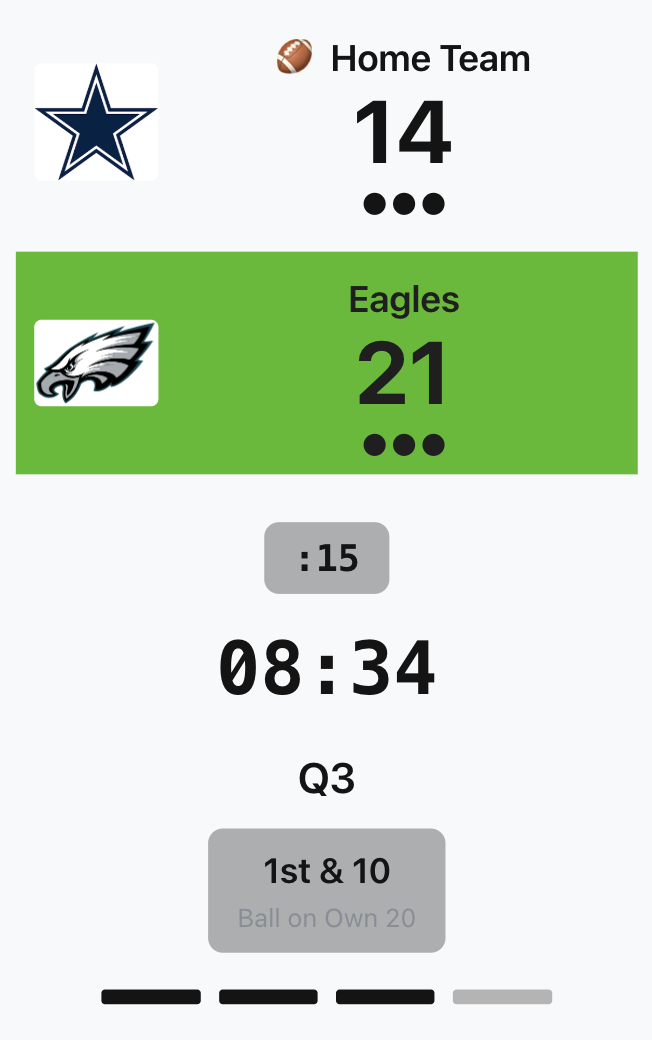
A paper or press-box tally still matters for the official record, but most sidelines, gyms, and streams also run a live display so players, coaches, and fans can see the score, quarter, and clock from anywhere. Create a free online football scoreboard →
Football Scoring FAQ
How many points is a touchdown worth?
6 points. The scoring team then chooses to attempt either a 1-point kick (extra point) or a 2-point conversion by running or passing the ball into the end zone again.
What is a safety in football, and how many points is it worth?
A safety is worth 2 points and is awarded to the defense. It happens when the offense is tackled with the ball in their own end zone, or commits certain fouls (like holding) while in their own end zone. The scoring team also gets the ball back via a free kick from the team that gave up the safety.
How many points is a field goal worth?
3 points, no matter the distance. The kicking team sends the ball through the uprights during a normal play, usually on 4th down when they're out of range or don't want to risk a turnover going for a touchdown.
What's the difference between an extra point and a two-point conversion?
Both follow a touchdown. An extra point is a kick from short range worth 1 point. A two-point conversion is a run or pass play from close range worth 2 points but with a lower success rate — teams usually kick unless the game situation calls for the extra point.
How does overtime work in football?
It depends on the level. The NFL plays a single overtime period where the game can end on the first score if the receiving team scores a touchdown; regular-season ties are possible. College and high school football use alternating possessions from a short field (25-yard or 10-yard line) with no game clock, continuing until one team leads after equal possessions.
Can a football game end in a tie?
Yes, in the NFL regular season, if the score is still tied after one overtime period. College and high school formats are built to always produce a winner since both teams keep getting possessions until the tie breaks.
What is the highest number of points you can score on one play?
A touchdown plus a two-point conversion is the most on a single scoring sequence (8 points), though technically a touchdown (6) is the single scoring play — the conversion attempt that follows is a separate play.
Start Keeping Score
Create a free online football scoreboard → for live games on the sideline, in the booth, or on stream.