
How Is Badminton Scored?
Badminton uses rally-point scoring, similar in feel to volleyball — a point is won on every rally regardless of who served. The details around winning a game, deuce, and the point cap are where scorekeepers usually need a refresher. Here's how badminton scoring works under the current BWF (Badminton World Federation) rules used almost everywhere, including the US.
Rally-Point Scoring: A Point Every Rally
A point is awarded at the end of every rally to whichever side wins it — no matter who served.
- Server wins the rally → they score a point and continue serving (switching service courts between left and right)
- Receiver wins the rally → they score a point AND win the serve
Like volleyball's rally scoring, this means the score always changes after every single rally — there's no dead point where nobody scores.
How to Win a Game
A game is won by the first side to reach 21 points, with at least a 2-point lead.
If the score reaches 20-20, play continues past 21 until one side leads by 2 (22-20, 23-21, and so on). If the score reaches 29-29, the next point wins the game outright — 30 points is a hard cap, no win-by-2 requirement applies at that ceiling.
| Situation | Rule |
|---|---|
| Reach 21 with a 2+ point lead | Game over |
| Tied 20-20 | Play continues, win by 2 |
| Reach 29-29 | Next point wins (cap at 30) |
Matches Are Best of 3 Games
A match is played to the best of 3 games (first to win 2 games wins the match). Between games, players switch ends of the court. If a deciding third game is needed, players also switch ends when the leading side reaches 11 points in that game — a mid-game reset similar to volleyball's deciding-set side switch.
Singles vs. Doubles: What Changes
The scoring system (rally point, 21 points, win by 2, cap at 30) is identical for singles and doubles. What changes is court dimensions (doubles uses the wider court boundary) and serving position:
- Singles — server serves from the right court when their score is even, left court when odd
- Doubles — the same even/odd serving-court rule applies, but which of the two partners serves rotates based on which side won the previous rally, and there's a specific server/receiver rotation pattern that trips up new scorekeepers most
For scorekeeping purposes, only the running point total matters for the display — the serving rotation is a player/umpire responsibility, not something reflected in the score itself.
In doubles, the rotation works like this: at the start of a game, one player serves from the right court. If the serving side wins the rally, the same player serves again from the alternate court (left, then right, then left). If the serving side loses the rally, the serve passes to the opponents — but only after both partners on the new serving side have had a chance to serve once each in future service turns, following an even/odd court pattern tied to the score. It's the single most common source of confusion for new umpires, which is why doubles matches typically have both an umpire and a service judge.
What Counts as a Fault
Not every dead rally is a clean point — some end because of a fault, which is simply a rule violation that ends the rally in the opponent's favor. Common faults include:
- The shuttle lands outside the court boundary
- The shuttle hits the ceiling, wall, or a fixture before landing
- A player touches the net with their racket or body during play
- A player's racket or body crosses under the net into the opponent's court and interferes with them
- The server or receiver isn't ready, or the server's racket contacts the shuttle above waist height (a service fault)
Whichever side didn't commit the fault wins the point — the scoring outcome is identical to winning a rally cleanly. A "let" (rare in badminton compared to other racket sports) stops play and replays the rally without awarding a point to either side, typically for an accidental disruption like a shuttle from another court entering play.
How to Keep Score by Hand
A simple badminton scoresheet just needs the rally number, who won it, and the running score — server tracking is optional unless you're also tracking serve rotation for doubles.
| Rally | Server | Winner | Running score (A-B) |
|---|---|---|---|
| 1 | A | A | 1-0 |
| 2 | A | B | 1-1 |
| 3 | B | B | 1-2 |
| 4 | B | A | 2-2 |
| 5 | A | A | 3-2 |
Because every rally produces a point, the sheet is simpler than side-out-scoring sports — there's no "no score" row to account for.
Using a Digital Scoreboard
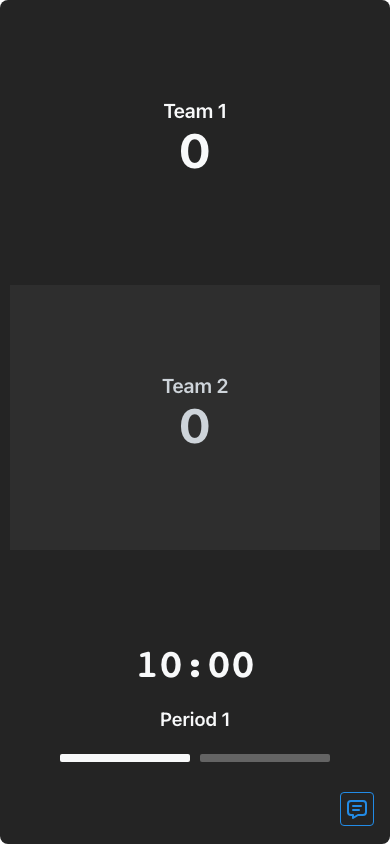
A live scoreboard makes the running score, game count, and match status visible across the court or gym without anyone needing to ask. Create a free online badminton scoreboard →
Badminton Scoring FAQ
How many points do you need to win a badminton game?
21 points, with at least a 2-point lead. If tied 20-20, play continues until one side is ahead by 2. If the score reaches 29-29, the next point wins outright — 30 is a hard cap with no win-by-2 requirement at that point.
How many games are in a badminton match?
A match is best of 3 games — the first side to win 2 games wins the match. Players switch ends after each game, and also mid-game in a deciding third game once the leader reaches 11 points.
Does the server always score the point in badminton?
No — badminton uses rally-point scoring, so a point is awarded to whoever wins the rally, regardless of who served. The receiving side scoring a point also means they win the serve for the next rally.
What happens if the score reaches 20-20?
Play continues past 21 until one side builds a 2-point lead (22-20, 23-21, etc.). This continues up to 29-29, at which point the next point wins the game regardless of lead size, capping the game at a maximum of 30 points.
Is badminton scoring different for doubles than singles?
The point system itself (rally scoring to 21, win by 2, cap at 30) is the same for both. What differs is the serving rotation — in doubles, which partner serves next depends on which side won the previous rally, following a specific rotation pattern that doesn't apply in singles.
Did badminton always use rally-point scoring?
No. Badminton historically used a side-out scoring system similar to old volleyball rules, where only the server could score. The switch to rally-point scoring (in the mid-2000s) shortened and standardized match length, similar to volleyball's own switch to rally scoring.
What is deuce in badminton?
"Deuce" refers to the 20-20 tie situation where the win-by-2 rule kicks in — play continues past the normal 21-point target until one side leads by 2, exactly like deuce in tennis extends a game past the standard point count.
What is a fault in badminton, and does it cost a point?
A fault is a rule violation — the shuttle landing out of bounds, touching the net, an illegal serve, and similar infractions. Because badminton uses rally-point scoring, a fault immediately awards the point to whichever side didn't commit it, the same as winning the rally outright.
Start Keeping Score
Create a free online badminton scoreboard → for club nights, school matches, and tournaments.