
Table Tennis Scoring (Ping Pong Scoring)
Table tennis and ping pong are the same game — "ping pong" is the informal name, "table tennis" is the official one — and they share one scoring system. Here's exactly how it works, including the rule most casual players get wrong: serve alternates every 2 points, not every point.
How to Score a Table Tennis Game (Step by Step)
- Start at 0-0. Decide who serves first (coin toss, or paddle spin).
- Play the rally. A point goes to whoever wins the rally, no matter who served.
- Track the serve count. After every 2 total points played, the serve switches to the other player/team.
- Check the score after each point. Has anyone reached 11 with a 2-point lead? If yes, game over.
- If the score reaches 10-10 (deuce), switch to serving every single point instead of every 2, and keep playing until one side leads by 2.
- Record the game winner, switch ends of the table, and start the next game at 0-0.
- Repeat until one player/team has won the majority needed for the match (3 of 5, or 4 of 7).
- In the deciding game of the match, switch ends again when the leader reaches 5 points — an extra mid-game switch that only happens in the final game.
Games to 11, Win by 2
A game is won by the first player (or team, in doubles) to reach 11 points, with at least a 2-point lead.
- If the score reaches 10-10, it's called deuce, and play continues past 11 until someone leads by 2 — 12-10, 15-13, 21-19, however long it takes.
- There's no scoring cap. A deuce game can theoretically run indefinitely if both sides keep tying it up.
Points are scored on every rally regardless of who served — whoever wins the point serves next in the normal rotation, described below. There's no "side-out" concept like in volleyball or pickleball; it's straightforward rally scoring.
Serve Alternates Every 2 Points
This is the rule that trips up new players: the serve changes every 2 points, not every point.
- Player/Team A serves points 1 and 2
- Player/Team B serves points 3 and 4
- Back to Player/Team A for points 5 and 6
- ...and so on, regardless of who's winning
At deuce (10-10 or later), the serve changes every single point instead of every 2. This keeps the serve advantage from swinging a long deuce game too heavily toward one side.
Serve Rotation Diagram
Doubles Serve Rotation
Doubles adds a receiving-order rule on top of the serve-every-2-points pattern: the serve must go diagonally (right-side to right-side), and the order of who serves and who receives rotates in a fixed sequence each time the serve changes — Player A1 serves to B1, then B1 serves to A2, then A2 serves to B2, then B2 serves to A1, repeating. Getting this rotation wrong is the most common doubles scoring error.
Deuce
Deuce is any tied score at 10-10 or later. Once you hit deuce:
- Win-by-2 still applies, but now the game can't end until someone is 2 points clear
- Serve alternates every point instead of every 2
- Games at deuce are commonly decided 12-10, but can go much longer
There's no cap and no sudden-death point at deuce in standard table tennis rules — the win-by-2 requirement holds no matter how long the game runs.
Worked Example: A Game That Reaches Deuce
| Point # | Score (A-B) | Who served | Serve switches? |
|---|---|---|---|
| 1 | 1-0 | A | — |
| 2 | 2-0 | A | — |
| 3 | 2-1 | B | Yes — after 2 points |
| 4 | 3-1 | B | — |
| 5 | 4-1 | A | Yes — after 2 points |
| ... | ... | ... | every 2 points, same pattern |
| — | 9-9 | — | still every 2 points |
| — | 10-9 | — | still every 2 points |
| — | 10-10 | — | Deuce — now every 1 point |
| — | 11-10 | B | Yes — after 1 point |
| — | 11-11 | A | Yes — after 1 point |
| — | 12-11 | B | Game over — 2-point lead reached |
Once the score hits 10-10, notice the serve column changes rhythm completely — every single point switches server instead of every 2. The game in this example ends 12-10.
Best-of Match Formats
A single game to 11 rarely decides a match on its own. Standard formats:
- Best of 5 (first to 3 games) — most common in casual, league, and many tournament formats
- Best of 7 (first to 4 games) — used in higher-level tournament and championship play
Players switch ends of the table after each game, and in the final game of a match, players switch ends again when the leader reaches 5 points — another small rule that only comes up in deciding games.
The Expedite Rule
The expedite rule exists to stop overly defensive, slow-paced games from dragging on. It kicks in if a game isn't finished after 10 minutes of play (and the total points scored is fewer than 18, roughly indicating a defensive stall).
Once expedite is invoked:
- Every remaining point in that game is served in alternating single-point rotation, regardless of the normal every-2-points rule
- The serving player must win the point within 13 of their own shots, or the point automatically goes to the receiver
This flips the incentive from stalling to attacking, since a server who can't close out a rally quickly just hands the point over. Expedite carries through for the rest of that match once triggered.
Old 21-Point System vs Modern 11-Point System
Before 2001, table tennis was played to 21 points, win by 2, with serve alternating every 5 points instead of every 2.
The International Table Tennis Federation switched to the 11-point system for a few practical reasons:
- Shorter games made for better TV coverage and spectator engagement
- More frequent serve changes (every 2 points instead of every 5) reduced any single server's ability to dominate a long stretch
- Faster-paced matches overall, since each individual game is much shorter
If you're playing with older equipment, older rulebooks, or just grew up on the 21-point version, know that it's functionally the same game — just a different target score and a different serve-rotation interval. Some recreational players still prefer 21 for longer rallies per game.
Table Tennis vs Ping Pong: Same Rules
There's no scoring difference between "table tennis" and "ping pong" — they're two names for the same sport. "Table tennis" is the term used in official/competitive contexts (ITTF, USATT, Olympic play); "ping pong" is the casual, everyday name, sometimes associated informally with basement or rec-room play using less regulation equipment. The scoring system above applies identically under either name.
Using a Digital Scoreboard
Because serve rotation and deuce rules change mid-game, a lot of casual games lose track of whose serve it actually is. A digital scoreboard handles both score and serve indicator so nobody has to remember the every-2-points rule mid-rally.
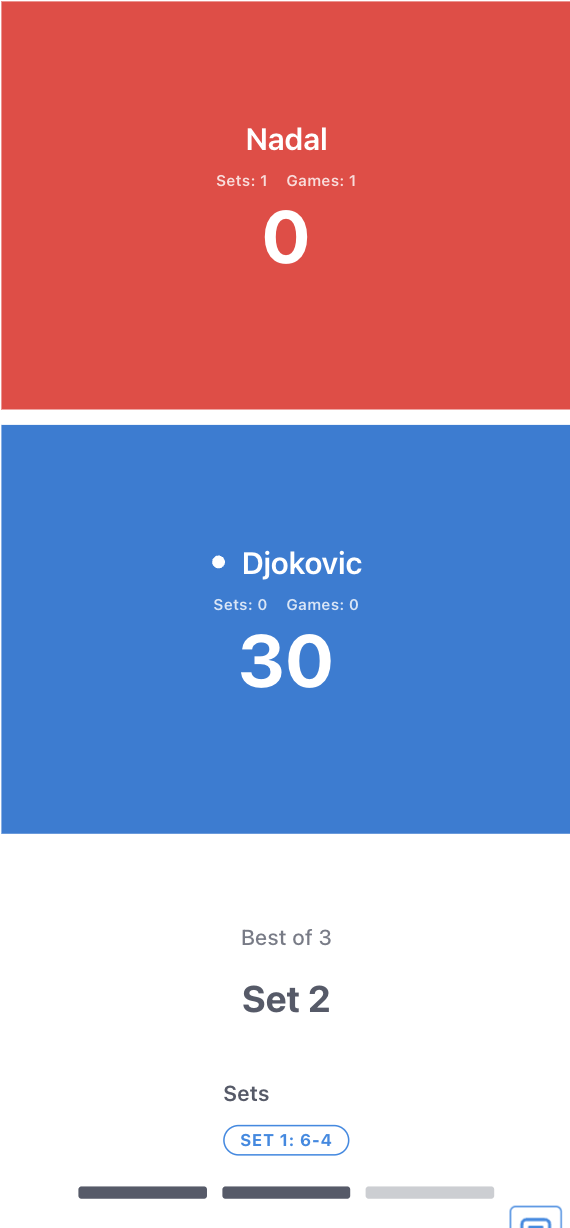
While there isn't a dedicated table tennis scoreboard live yet, the tennis scoreboard or a general-purpose online scoreboard can be configured for game-based sports like table tennis in the meantime — set your win target to 11 and track sets as games.
Table Tennis / Ping Pong Scoring FAQ
How do you score in table tennis?
Play to 11 points, win by 2. A point is scored on every rally regardless of who served. Serve alternates every 2 points, except during deuce (10-10 or later), when it alternates every single point.
Is ping pong scoring different from table tennis scoring?
No — "ping pong" and "table tennis" are the same game with identical scoring rules. Table tennis is the formal/competitive name; ping pong is the casual name. Games to 11, win by 2, serve every 2 points.
What is deuce in table tennis?
Deuce is a tied score of 10-10 or later. Once at deuce, the game continues until one player leads by 2 points, and the serve switches every single point instead of every 2 points, to keep serve advantage fair during a long finish.
How many games do you need to win a table tennis match?
Most matches are best of 5 (first to win 3 games) or best of 7 (first to win 4 games) at higher levels. Each individual game is played to 11 points, win by 2.
What is the expedite rule in table tennis?
The expedite rule speeds up a slow-paced game that's gone past 10 minutes without a decision. It forces alternating single-point serves and requires the server to win each point within 13 of their own shots, or the point automatically goes to the receiver.
What was the old table tennis scoring system?
Before 2001, table tennis was played to 21 points (win by 2), with serve alternating every 5 points instead of every 2. The switch to 11-point games shortened matches and increased how often the serve changed hands.
Keep Score Easily
Check out the tennis scoreboard for a game-based live display you can adapt for table tennis and ping pong matches.