
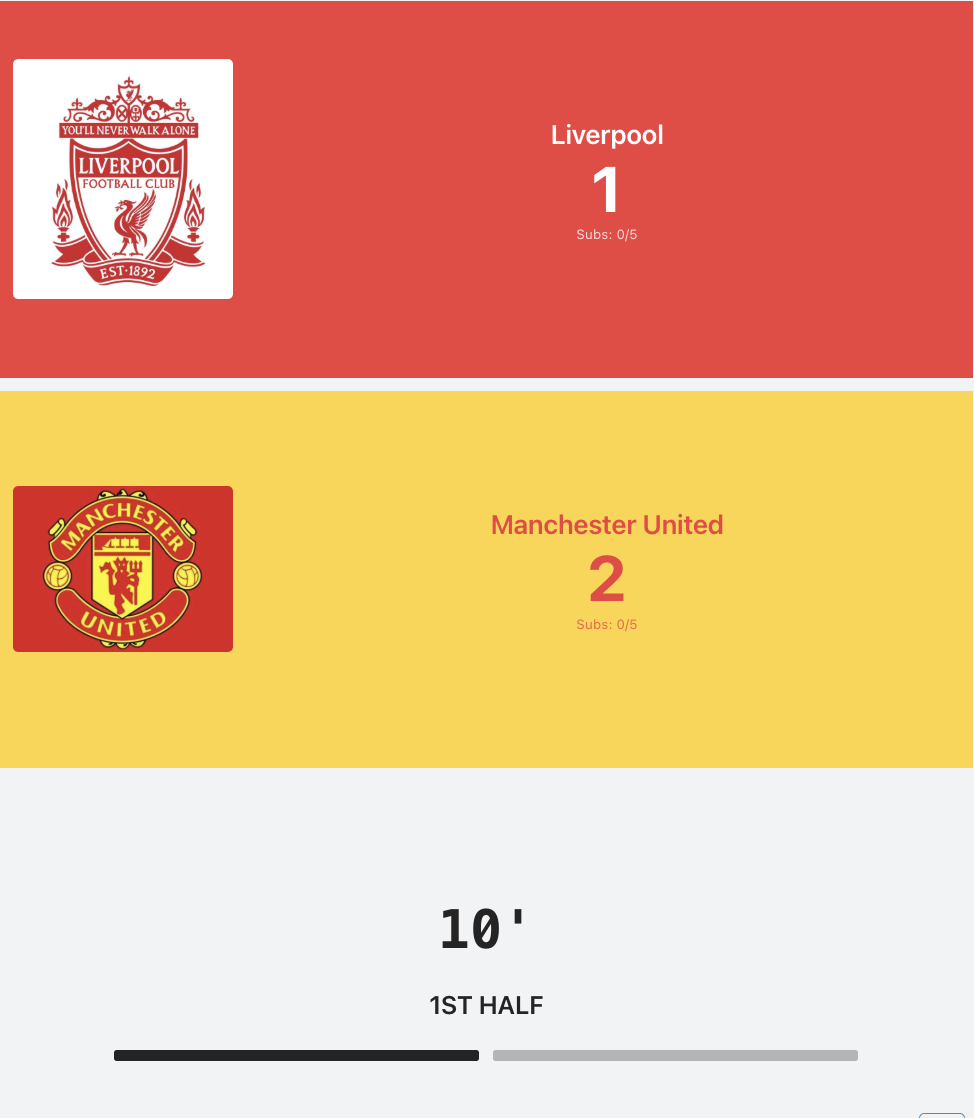
How to Keep Score in Soccer
Keeping score in soccer means counting one goal each time the ball fully crosses the opponent's goal line, plus tracking league points and tiebreakers for standings. Soccer scoring seems simple—kick the ball into the net, score a goal. But if you're running a league, keeping an official score sheet, or trying to understand standings, there's more to know. This guide covers everything from basic scoring to league tiebreakers.
Basic Scoring Rules
How to Score a Goal
A goal is scored when:
- The entire ball crosses the goal line
- Between the goalposts and under the crossbar
- No foul was committed by the attacking team
- The player was not offside
Key detail: The ball must completely cross the line. If any part of the ball is on or above the line, it's not a goal.
Match Score
The score tracks total goals by each team:
- Home team listed first (or left)
- Away team listed second (or right)
Example: Manchester United 2 - 1 Liverpool
- Manchester United scored 2 goals
- Liverpool scored 1 goal
- Manchester United wins
Win, Loss, Draw
Soccer matches can end in three results:
- Win: Team with more goals (3 points in most leagues)
- Loss: Team with fewer goals (0 points)
- Draw/Tie: Equal goals (1 point each)
Unlike American sports, ties are common and acceptable in soccer leagues.
League Standings & Points
Most soccer leagues use a 3-1-0 point system:
| Result | Points |
|---|---|
| Win | 3 |
| Draw | 1 |
| Loss | 0 |
Example standings after 5 games:
| Team | W | D | L | Pts |
|---|---|---|---|---|
| Team A | 4 | 1 | 0 | 13 |
| Team B | 3 | 1 | 1 | 10 |
| Team C | 2 | 2 | 1 | 8 |
| Team D | 1 | 0 | 4 | 3 |
Team A: 4 wins (12 pts) + 1 draw (1 pt) = 13 points
Goal Difference (GD)
Goal difference is used as a tiebreaker and appears in standings:
Formula: Goals Scored - Goals Allowed = Goal Difference
Example:
- Team A: Scored 15, Allowed 5 → GD = +10
- Team B: Scored 10, Allowed 10 → GD = 0
- Team C: Scored 5, Allowed 12 → GD = -7
Higher goal difference is better. A team that wins 5-0 has a better GD than one that wins 1-0.
Why GD Matters
When teams have equal points, goal difference usually determines position:
| Team | Pts | GD | Position |
|---|---|---|---|
| Team A | 10 | +5 | 1st |
| Team B | 10 | +2 | 2nd |
| Team C | 10 | -1 | 3rd |
All three teams have 10 points, but Team A finishes first due to best goal difference.
Tiebreaker Rules
When points and goal difference are equal, leagues use additional tiebreakers:
Standard Tiebreaker Order
- Points (most points wins)
- Goal difference (GD)
- Goals scored (more goals = higher position)
- Head-to-head result (who won when they played?)
- Head-to-head GD (goal difference in matches between tied teams)
- Fair play (fewer cards = higher position)
- Playoff match (rare, used for critical positions)
Head-to-Head Example
Team A and Team B both have 25 points and +8 GD:
- Their match: Team A 2 - Team B 1
- Team A wins the tiebreaker (head-to-head result)
Some leagues (like La Liga) use head-to-head before goal difference. Know your league's rules.
Scorekeeping for Different Formats
League Play
Track for each team across the season:
- Games Played (GP)
- Wins (W)
- Draws (D)
- Losses (L)
- Goals For (GF)
- Goals Against (GA)
- Goal Difference (GD)
- Points (Pts)
Tournament / Cup Play
Most tournaments use single elimination in later rounds:
- Win: Advance to next round
- Draw after 90 min: Extra time (30 min)
- Still tied: Penalty shootout
Penalty shootout results are often listed as "5-4 (3-3)" meaning 5-4 on penalties, 3-3 after extra time.
Pool Play
In tournaments with group stages (like World Cup):
- 4 teams per group, round robin
- Top 2 advance to knockout rounds
- Same points/GD tiebreakers apply
Official Score Sheet
If you're keeping the official record, track:
Basic Information
- Date and kickoff time
- Field/venue
- Team names
- Referee name
During the Match
For each goal:
- Time scored (e.g., 23' means 23rd minute)
- Scoring player name/number
- Assist (optional)
- Own goals noted separately
Example:
Manchester United 2 - 1 Liverpool
23' - Rashford (Fernandes assist)
67' - Salah
89' - Martial
Other Events to Track
- Substitutions (time, players in/out)
- Yellow cards (time, player)
- Red cards (time, player)
- Injuries requiring stoppage
Stoppage Time
The referee adds time for stoppages (injuries, substitutions, time wasting):
- 1st half: Shown as "45+3" (45 minutes + 3 added)
- 2nd half: Shown as "90+5"
Goals in stoppage time are recorded as "90+2'" etc.
Scoring Rules by Level
Professional / FIFA Rules
- 90 minutes (two 45-minute halves)
- Extra time: 30 minutes (two 15-minute halves)
- Penalty shootout if still tied
- VAR may review goal decisions
College (NCAA)
- 90 minutes (two 45-minute halves)
- Overtime: Two 10-minute "golden goal" periods
- PKs if still tied after overtime
- Regular season games can end in draws
High School (NFHS)
- 80 minutes (two 40-minute halves)
- Varies by state
- Overtime rules differ by state/tournament
Youth Soccer
- Shortened games based on age:
- U8: 4x10 minute quarters
- U10: 2x25 minute halves
- U12: 2x30 minute halves
- U14: 2x35 minute halves
- U16+: 2x40-45 minute halves
Many youth leagues don't keep official standings or use "no score" policies for youngest ages.
Special Scoring Situations
Own Goals
When a player accidentally puts the ball in their own goal:
- Counts as a goal for the opposing team
- No player from the scoring team is credited
- Recorded as "OG" or "own goal"
Example: Team A 2 - 1 Team B
- 15' - Smith
- 34' - Jones (OG) — Jones plays for Team A, this goal is for Team B
- 78' - Williams
Penalty Kicks
A penalty kick (PK) is awarded for fouls in the penalty area:
- Taken from the penalty spot (12 yards out)
- Only goalkeeper vs kicker
- Goal counts as normal goal
Penalty Shootout
After extra time in knockout rounds:
- 5 PKs per team
- Team with most goals after 5 wins
- If tied, sudden death (one PK each until someone misses and other scores)
Shootout results don't count toward goal totals—the match score remains the tied score.
Example:
- Match score: 2-2 (after extra time)
- Shootout: 5-4
- Recorded as: Team A 2(5) - 2(4) Team B
- Team A advances
Away Goals Rule (Historical)
Previously used in two-leg ties:
- If aggregate tied, team with more away goals advanced
- Largely abolished in 2021 by UEFA and others
Now most competitions go straight to extra time if aggregate is tied.
Digital Scorekeeping Tools
What to Track Live
For real-time scoring during matches:
- Current score
- Time elapsed
- Recent goals/events
League Management
For season-long tracking:
- Standings table
- Results by matchday
- Goal scorers
Tournament Brackets
For cup competitions:
- Bracket progression
- Results per round
Soccer Scoring FAQ
How to score in soccer
You score a goal in soccer by getting the entire ball across the goal line, between the posts, under the crossbar — without committing a foul or being offside. Every goal is worth one point on the scoreboard. The team with the most goals at the end of regulation (and any extra time) wins.
How many points is a goal worth in soccer?
A goal in soccer is worth one point on the match scoreboard, no matter how it was scored. There are no field goals, free throws, or multipliers. A header from a corner counts the same as a 30-yard volley — one goal, one point.
How do you score in soccer?
Get the ball into the opponent's net legally — using any part of your body except your hands and arms (goalkeepers can use hands within their own penalty area). Common ways to score: shots from open play, headers, free kicks, corner kicks, and penalty kicks. Own goals count for the attacking team.
How does scoring work in soccer?
Every goal counts as one point on the scoreboard. The match score is shown as Home — Away (for example, "Manchester United 2 — 1 Liverpool"). In league play, a win earns 3 points in the standings, a draw earns 1, and a loss earns 0. Tiebreakers usually go to goal difference (goals scored minus goals allowed) and then total goals scored.
Soccer scoring system explained
Match scoring is simple: each goal is one point, most goals wins. League scoring is the 3-1-0 system — 3 points for a win, 1 for a draw, 0 for a loss. Standings tiebreakers vary by competition but typically go: points → goal difference → goals scored → head-to-head.
What is a "soccer score board" and is it the same thing as a soccer scoreboard?
Yes — "soccer score board", "scoreboard soccer", and "soccer scoreboard online" all describe the same tool: a live display of the soccer match score, time, and any cards or substitutions. The scoreboard sits sideline or on a TV in the clubhouse so players, coaches, and parents can see the score without asking.
Open a free soccer scoreboard online →
Quick Reference
Points System
- Win: 3 points
- Draw: 1 point
- Loss: 0 points
Tiebreaker Order (Most Leagues)
- Points
- Goal difference
- Goals scored
- Head-to-head
- Fair play / Playoff
Goal Difference Formula
GD = Goals Scored - Goals Allowed
Game Length
- Pro: 90 min (2x45)
- College: 90 min (2x45)
- High School: 80 min (2x40)
- Youth: Varies by age
Ready to Track Your Soccer Matches?
Whether you're running a league or just keeping score for a tournament:
Now get out there and keep the score—properly.