
How to Keep Score in Baseball
Baseball scorekeeping is an art form that's been refined over 150 years. Whether you're keeping a casual scorecard in the stands, running an official scorebook for a Little League game, or just trying to understand what all those numbers on TV mean, this guide has you covered.
Basic Scoring: How Runs Work
What Is a Run?
A run scores when a player successfully touches all four bases (first, second, third, home) in order. Unlike most sports, you don't score by hitting the ball into something—you score by running.
How to Score a Run
- Batter reaches base (hit, walk, error, etc.)
- Advances around the bases
- Touches home plate before the third out
Key rule: Runs don't count if the third out is made before the runner touches home (with exceptions for force plays).
Ways to Reach Base
- Hit: Ball lands in fair territory, batter reaches safely
- Walk (BB): 4 balls, batter goes to first
- Hit by Pitch (HBP): Pitcher hits batter, batter goes to first
- Error (E): Fielder mishandles ball, batter reaches
- Fielder's Choice (FC): Fielder throws elsewhere, batter reaches
- Dropped Third Strike: Catcher drops strike three, batter can run
The Line Score
The line score is the inning-by-inning summary you see on scoreboards:
           1  2  3  4  5  6  7  8  9   R  H  E
Yankees    0  1  0  2  0  0  1  0  3   7  12  1
Red Sox    2  0  0  0  1  0  0  0  0   3   8  0
Reading the Line Score
- Columns 1-9: Runs scored in each inning
- R: Total runs (the score)
- H: Total hits
- E: Total errors
In this example: Yankees won 7-3, with 12 hits and 1 error. Red Sox had 3 runs, 8 hits, 0 errors.
Why Track Hits and Errors?
- Hits show offensive performance
- Errors show defensive mistakes
- A team can score runs without hits (walks + errors)
- More hits than runs often means leaving runners on base
What Does R.H.E. Mean on a Baseball Scoreboard?
If you've watched a baseball game on TV or looked up at a scoreboard at the park, you've seen three letters next to the score: R.H.E. Together they tell you everything about a team's performance in one glance.
R.H.E. Stands For:
- R = Runs. The actual score — how many times a player crossed home plate.
- H = Hits. Total base hits (singles, doubles, triples, home runs). Walks and reaching on errors do not count as hits.
- E = Errors. Defensive mistakes that should have been outs but weren't.
How to Read R.H.E. on a Baseball Scoreboard
           R   H   E
Yankees    7   12  1
Red Sox    3   8   0
Reading left to right: Yankees won 7–3 (R), got 12 hits (H), and committed 1 fielding error (E). Red Sox scored 3 runs on 8 hits with a clean defensive game (0 errors).
What R.H.E. Tells You at a Glance
- High R, low H → the team scored mostly on walks, errors, or sacrifice flies (small ball or wild pitching)
- Low R, high H → lots of baserunners but couldn't drive them in (left on base)
- High E → defensive collapse; expect unearned runs in the box score
What Does R.H.E. Mean in the Box Score?
R.H.E. on the line score is the team total. In the player-by-player box score you'll see the same letters next to individual stats:
- R for a batter = times that batter scored a run
- H for a batter = base hits
- E in fielding stats = errors charged to that player (E6 means an error by the shortstop)
R.H.E. is just the bookkeeping shorthand baseball has used since the 1800s. It's the easiest way to read a baseball scoreboard quickly.
How Many Points Is a Home Run?
Trick question — baseball doesn't use "points," it uses runs. A home run is worth as many runs as there are players on base when the ball leaves the park, plus the batter:
- Solo home run = 1 run
- 2-run home run = 1 baserunner + the batter = 2 runs
- 3-run home run = 3 runs
- Grand slam = bases loaded + the batter = 4 runs (the maximum on a single swing)
So a home run is worth between 1 and 4 runs. Each run shows up as +1 in that inning's box on the line score and +1 to the team's R column.
The Box Score
The box score provides detailed statistics for each player:
Batting Stats
| Player | AB | R | H | RBI | BB | SO | AVG |
|---|---|---|---|---|---|---|---|
| Smith | 4 | 1 | 2 | 1 | 0 | 1 | .289 |
| Jones | 3 | 0 | 0 | 0 | 1 | 2 | .245 |
| Williams | 4 | 2 | 3 | 2 | 0 | 0 | .312 |
Key stats:
- AB: At bats (plate appearances minus walks, HBP, sacrifices)
- R: Runs scored
- H: Hits
- RBI: Runs batted in (runs that scored because of this batter's action)
- BB: Walks
- SO: Strikeouts
- AVG: Batting average (hits ÷ at bats)
Pitching Stats
| Pitcher | IP | H | R | ER | BB | SO | ERA |
|---|---|---|---|---|---|---|---|
| Johnson | 6.0 | 6 | 3 | 2 | 2 | 7 | 3.15 |
| Miller | 2.0 | 2 | 0 | 0 | 0 | 3 | 2.80 |
| Davis | 1.0 | 0 | 0 | 0 | 1 | 1 | 1.92 |
Key stats:
- IP: Innings pitched (6.0 = 6 complete innings, 5.2 = 5⅔ innings)
- H: Hits allowed
- R: Runs allowed
- ER: Earned runs (runs not caused by errors)
- BB: Walks allowed
- SO: Strikeouts
- ERA: Earned run average (ER per 9 innings)
Scoring Notation
If you're keeping a written scorecard, here's the standard notation:
Position Numbers
Each position has a number:
- 1 = Pitcher (P)
- 2 = Catcher (C)
- 3 = First Base (1B)
- 4 = Second Base (2B)
- 5 = Third Base (3B)
- 6 = Shortstop (SS)
- 7 = Left Field (LF)
- 8 = Center Field (CF)
- 9 = Right Field (RF)
Hit Notation
- 1B or — = Single (one line)
- 2B or = = Double (two lines)
- 3B or ≡ = Triple (three lines)
- HR or ◊ = Home run (diamond)
Out Notation
Flyout: F + position number
- F7 = Flyout to left field
- F9 = Flyout to right field
Groundout: Position numbers showing who fielded to whom
- 6-3 = Shortstop to first base
- 4-3 = Second base to first base
- 5-3 = Third base to first base
Strikeout:
- K = Strikeout (swinging)
- Ꝁ (backwards K) = Strikeout looking (called third strike)
Double play:
- 6-4-3 = Shortstop → second base → first base (classic DP)
- 4-6-3 = Second base → shortstop → first base
Other Notations
- BB = Walk (base on balls)
- HBP = Hit by pitch
- E + position = Error (E6 = shortstop error)
- FC = Fielder's choice
- SB = Stolen base
- CS = Caught stealing
- WP = Wild pitch
- PB = Passed ball
- BK = Balk
Sample At-Bat Notation
Player singles, steals second, scores on a single:
[—] → SB → Scored on Jones single
Player strikes out looking:
[Ꝁ]
Player grounds into double play:
[6-4-3]
Innings Explained
Standard Game Length
- MLB: 9 innings
- College: 9 innings
- High School: 7 innings
- Little League: 6 innings
Half Innings
Each inning has two halves:
- Top: Visiting team bats
- Bottom: Home team bats
Three outs end each half inning.
Extra Innings
If tied after 9 (or regulation), play continues:
- Additional innings until one team leads after a complete inning
- MLB uses "ghost runner" rule (runner starts on 2nd in extras)
- Some leagues have tie rules or innings limits
Mercy Rule / Run Rule
Many youth and amateur leagues end games early for large leads:
- 10-run rule: Game ends if team leads by 10+ after 5 innings
- Varies by league (8 runs, 15 runs, etc.)
How to Read a Baseball Scoreboard
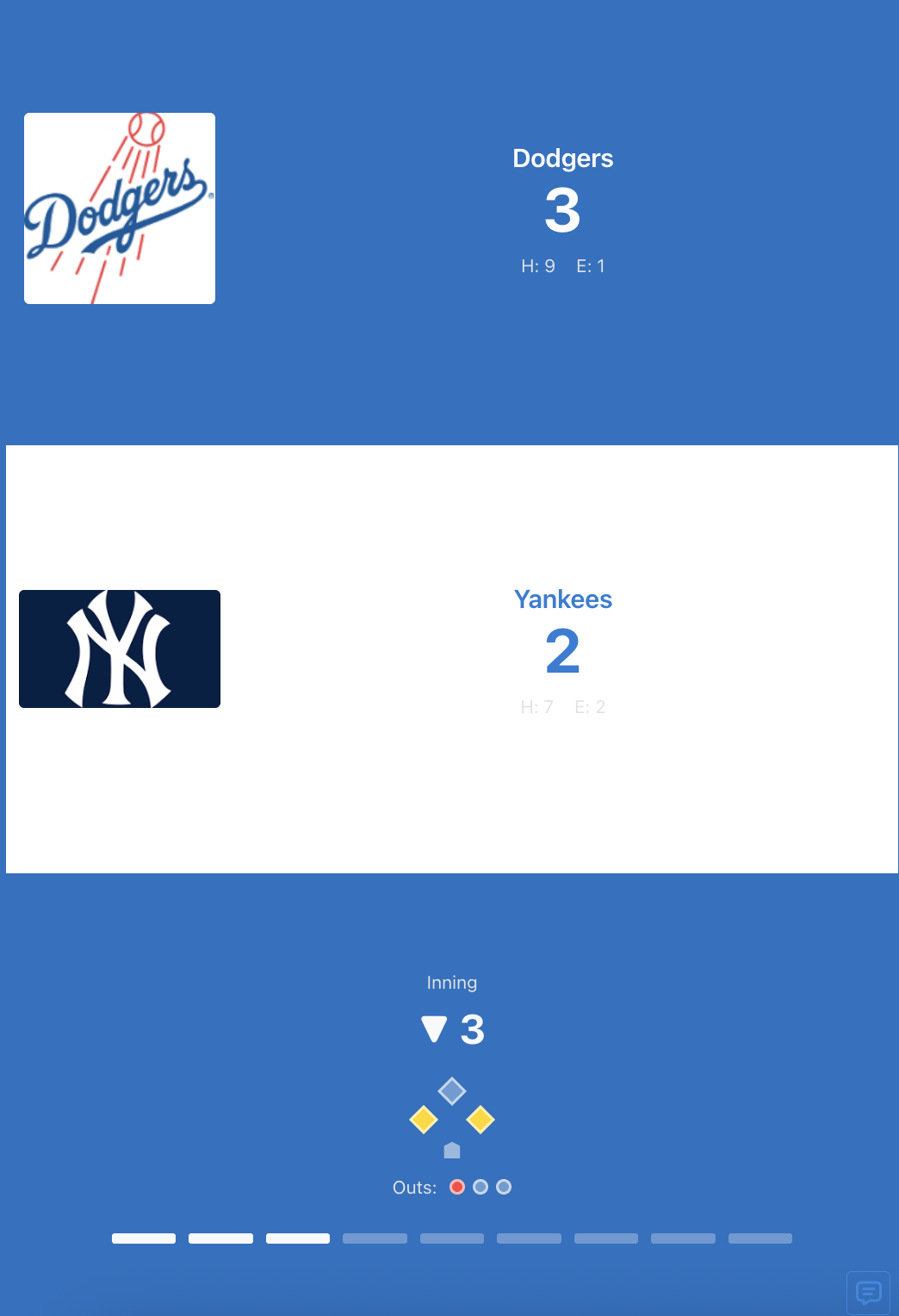
The baseball scoreboard packs a lot of information into a small space. Once you know what each section means, you can glance at any baseball scoreboard — at a Little League park, in MLB, or on a TV broadcast — and instantly understand the game state.
Basic Baseball Scoreboard Layout
INNING: 5
       R  H  E
HOME   3  6  1
AWAY   2  4  0

BALLS: 2
STRIKES: 1
OUTS: 1
What you're looking at:
- Inning = which inning is being played
- R / H / E = runs, hits, errors (see the R.H.E. section above)
- Balls / Strikes / Outs = the count and outs for the current at-bat
Full Baseball Scoreboard (with line score)
           1  2  3  4  5  6  7  8  9   R  H  E
VISITORS   0  2  0  0  1  -  -  -  -   3  5  0
HOME       1  0  0  2  -  -  -  -  -   3  6  1

B: 1  S: 2  O: 2
The numbered columns 1–9 are individual innings. Dashes indicate innings not yet played. The R, H, and E columns sum the totals — that's the line score.
Baseball Scoreboard Explained, Section by Section
| Section | What It Shows |
|---|---|
| Inning columns (1-9) | Runs scored each inning |
| R | Total runs (the score) |
| H | Total hits |
| E | Total errors |
| B / S | Balls and strikes on the current batter |
| O | Outs in the current half-inning |
If you want to keep your own baseball scoreboard online — for a Little League game, a backyard tournament, or a TV-style broadcast overlay — try our free baseball scoreboard:
Earned vs. Unearned Runs
This distinction matters for pitcher statistics:
Earned Run (ER)
A run that scored without the help of errors or passed balls:
- Runner reaches on hit, scores on another hit = Earned
- Runner walks, advances on hits, scores = Earned
Unearned Run
A run that would not have scored without errors:
- Runner reaches on error, eventually scores = Unearned
- Runner who should've been out scores = Unearned
Example:
- Batter reaches on shortstop error
- Next batter hits home run
- The runner who reached on error is unearned
- The batter who hit the HR is earned (he got a hit)
Earned runs affect ERA; total runs affect the score.
Situational Scoring
Sacrifice Fly
- Runner on 3rd, less than 2 outs
- Batter hits fly ball caught for an out
- Runner tags and scores
- Batter credited with RBI, no at-bat charged
Sacrifice Bunt
- Runner on base
- Batter bunts to advance runner, gets thrown out
- Batter credited with sacrifice, no at-bat charged
Run Batted In (RBI)
Credited when batter's action causes a run to score:
- Hit that drives in a run ✓
- Walk with bases loaded ✓
- Sacrifice fly ✓
- Ground out that scores a runner ✓
- Error that allows run (no RBI)
- Wild pitch/passed ball (no RBI)
Runs Scored
A player is credited with a "Run" when they cross home plate. This is different from RBI—you can score without anyone getting an RBI (wild pitch, error, etc.).
Win/Loss/Save Decisions
Starting Pitcher Win
Requirements:
- Pitch at least 5 innings
- Team leads when you exit and never trails after
- Team wins
Relief Pitcher Win
- Team was trailing or tied when you entered
- Team takes lead while you're pitcher of record
- Lead is never lost
Loss
- You were pitching when opposing team took the lead they never lost
Save
Requirements:
- You finish the game for the winning team
- You're not the winning pitcher
- AND one of these:
- Enter with lead of 3 or fewer runs, pitch at least 1 inning
- Enter with tying run on base, at bat, or on deck
- Pitch 3 or more effective innings
Digital Scorekeeping
During the Game
For live tracking, you need:
- Current score
- Inning (top/bottom)
- Outs
- Count (balls/strikes)
- Base runners (optional)
Season Statistics
For league management:
- Team standings (W-L record)
- Individual batting stats
- Individual pitching stats
Tournament Brackets
For playoff tracking:
- Bracket progression
- Game results
Quick Reference
Position Numbers
1-P, 2-C, 3-1B, 4-2B, 5-3B, 6-SS, 7-LF, 8-CF, 9-RF
Common Ground Outs
- 6-3: Shortstop to first
- 4-3: Second to first
- 5-3: Third to first
- 3U: First baseman unassisted
Strikeout Notation
- K: Swinging
- Ꝁ: Looking
Game Length
- MLB/College: 9 innings
- High School: 7 innings
- Little League: 6 innings
Line Score Order
Team | 1 | 2 | 3 | ... | R | H | E
Start Tracking Your Games
Whether you're scoring in the stands or running a league:
Play ball!