
How to Keep Score in Basketball
Keeping score in basketball means tracking points (2 or 3 for a field goal, 1 for a free throw), fouls, and timeouts for both teams over four quarters. You know a free throw is 1 point. You're here because something confusing happened during a game and you need answers. Let's skip the basics and get into the stuff that actually trips people up.
The Possession Arrow (Finally Explained)
This confuses everyone. Here's how it actually works:
The game starts with a jump ball. Whichever team doesn't win that jump ball gets the arrow pointing their way. From then on, every "jump ball situation" goes to whoever the arrow points to—and then it flips.
Jump ball situations include:
- Two players grab the ball simultaneously
- Ball goes out of bounds and refs can't determine who touched it last
- Double foul during a loose ball
- Ball gets stuck on the rim (rare but happens)
The arrow alternates all game. If you lose the opening tip, you get the next jump ball situation. Then they get the next one. And so on.
At halftime: The arrow determines who gets the ball to start the second half. If it's pointing to Team A, they get the ball—and then the arrow flips to Team B.
Need a visual? Use our free Possession Arrow Tool or check out the full Basketball Rules Reference.
When Does the Clock Actually Stop?
This varies by level, which is why it's confusing:
Clock stops for (all levels):
- Fouls
- Timeouts
- Out of bounds
- End of quarter/half
- Free throws
Clock stops for made baskets:
- NBA: Only in final 2 minutes of each half
- College: Only in final minute of each half
- High School: Never (unless state rules differ)
- Youth: Usually never
Clock stops after defensive rebounds:
- NBA: Never
- College: Never
- High School: Never
- Youth: Varies by league
This is why NBA games take 2.5 hours for 48 minutes of play, but a youth game finishes in 45 minutes.
The Bonus System (Without the Confusion)
When a team commits too many fouls, their opponents shoot free throws even on non-shooting fouls. But the rules differ:
High School & College (per half):
- Fouls 1-6: No bonus
- Fouls 7-9: "One-and-one" (make the first to shoot the second)
- Fouls 10+: Two shots guaranteed ("double bonus")
NBA (per quarter):
- Fouls 1-4: No bonus
- Fouls 5+: Two shots guaranteed (no one-and-one exists)
The reset: Foul counts reset at halftime (high school/college) or each quarter (NBA).
Why this matters for scorekeepers: You need to track team fouls and announce when a team enters the bonus. Refs should know, but they're watching the play—you're watching the book.
Intentional Foul vs. Flagrant Foul vs. Technical
These get mixed up constantly:
Intentional Foul (High School/College term):
- Deliberate foul with no play on the ball
- Two free throws + ball back
- Not necessarily violent, just strategic
Flagrant Foul:
- Excessive or violent contact
- Flagrant 1: Two free throws + ball back
- Flagrant 2: Same as above + ejection
- NBA reviews these; refs can upgrade/downgrade
Technical Foul:
- Unsportsmanlike conduct (arguing, taunting, hanging on rim)
- Two free throws + ball at half court
- Two technicals = ejection
For scorekeepers: Technicals count toward the team foul total. Flagrants don't (the free throws are a separate penalty).
And-One Scenarios
A player gets fouled while shooting and makes the basket. What happens?
- The basket counts (2 or 3 points)
- They shoot ONE free throw
- If they make it, that's an "and-one" (or a 4-point play if it was a three-pointer)
The confusing part: If they MISS the shot while being fouled, they shoot the normal number of free throws (2 for a two-point attempt, 3 for a three-point attempt). The "and-one" only applies when the shot goes in.
Overtime Rules
Game tied at the end of regulation? Here's what happens:
Length:
- NBA: 5 minutes
- College: 5 minutes
- High School: 4 minutes
- Youth: Often 2-3 minutes
Fouls: Team fouls reset for overtime. Personal fouls do NOT reset (if a player has 4 fouls, they still have 4).
Timeouts: Each team usually gets 1-2 additional timeouts for overtime.
Multiple overtimes: If still tied, play another overtime. Each overtime is a fresh period for team fouls.
The Shot Clock
Not all levels have one:
- NBA: 24 seconds
- College (Men's): 30 seconds
- College (Women's): 30 seconds
- High School: 35 seconds (only in some states—many have none)
- Youth: Rarely used
Shot clock resets to:
- Full time after a change of possession
- NBA: 14 seconds after offensive rebound
- College: 20 seconds after offensive rebound
Violation: If the shot clock expires without the ball hitting the rim, the other team gets the ball.
For a complete breakdown by league, see our Shot Clock Rules Guide.
Backcourt Violation
Once the offensive team crosses half court with the ball, they can't go back. But the details matter:
- The ball and both feet must cross the line to establish frontcourt
- If they step back or pass back across, it's a violation
- On a throw-in: The line doesn't count until the ball crosses it—you can throw it to someone near halfcourt
Not a violation:
- Defense tips the ball into backcourt (offense can recover it)
- Jump ball in frontcourt where arrow points to team in backcourt (they get 10 seconds to advance)
What Scorekeepers Actually Track
The official scorebook includes:
For each player:
- Jersey number
- Personal fouls (mark each one; 5th = fouled out)
- Points (running tally helps)
- Time in/out of game (for substitution records)
For each team:
- Running score
- Team fouls per quarter/half
- Timeouts used
- Possession arrow direction
For the game:
- Final score by quarter
- Officials' names
- Date, time, location
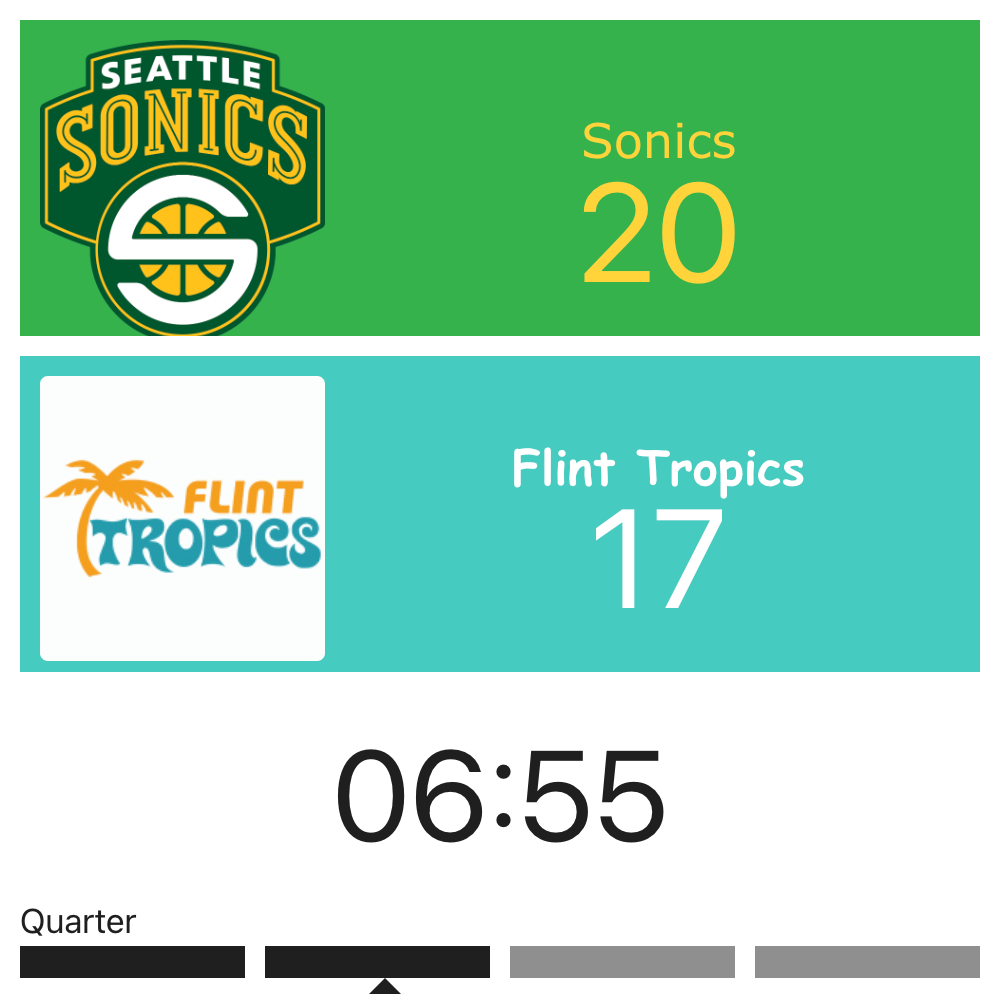
Using a Digital Scoreboard
Paper scorebooks are the official standard, but a digital scoreboard helps everyone else follow along:
- Parents in the stands can see the score clearly
- Family watching remotely can follow along
- Coaches can glance at foul counts without asking
- No squinting at a tiny flip scoreboard across the gym
Create a free basketball scoreboard →
Common Scorekeeper Mistakes
Forgetting to flip the possession arrow after a jump ball situation. The arrow should change every time it's used.
Not announcing bonus status when a team hits 7 fouls. The refs should track this, but a good scorekeeper calls it out.
Missing the foul on a made basket. If there's a foul on a successful shot, mark the foul AND the points. Easy to forget one.
Losing track after a timeout. The game stops, you chat with someone, play resumes—and now you're not sure whose ball it is. Stay locked in.
Basketball Scoring FAQ
What are field goals in basketball?
A field goal in basketball is any made basket that isn't a free throw. It includes 2-point shots (anything from inside the three-point line) and 3-point shots (from beyond the line). On the box score you'll see FGM/FGA (field goals made / attempted) — that counts everything except free throws. Free throws have their own column, FTM/FTA.
What is a field goal in basketball worth?
A field goal is worth 2 points if shot from inside the three-point arc and 3 points if shot from behind the arc. Free throws aren't field goals — they're worth 1 point each.
Field goal vs three-pointer
A three-pointer is a field goal — just one taken from beyond the three-point line. The "FG%" stat lumps 2s and 3s together. The "3P%" stat tracks just three-point attempts. So if a player goes 5/10 from the field with three of those being threes, they shot 50% FG and 30% 3P.
What does PA mean in basketball?
PA in basketball standings stands for Points Against — the total points scored against the team across the season. PF (Points For) is the total scored. PA is used as a tiebreaker and is a strong indicator of a team's defensive strength.
What is a basketball score keeper?
A basketball score keeper (or "scorekeeper") is the person at the scorer's table who tracks the official score, fouls, timeouts, and possession arrow during a game. The score keeper is also responsible for the official score book — the paper record of every basket and foul. ScoreKeeperCo's digital basketball scoreboard runs on any phone or tablet and gives the score keeper a one-tap interface, while also displaying the score on a TV or projector for everyone in the gym.
Is there a basketball scoreboard app I can use online?
You don't need to install anything — ScoreKeeperCo runs in any browser as a free basketball scoreboard online. Add it to your phone's home screen and it works exactly like a basketball scoreboard app. No app store, no signup. Use it as the public scoreboard on a TV and as the score keeper interface on your phone at the same time.
Basketball scoring system in one paragraph
A made basket from inside the arc is 2 points. A made basket from beyond the arc is 3 points. A made free throw is 1 point. There are no half-points or modifiers — every score is one of points. The team with the most total points at the end of the game wins; if tied, you go to overtime.
Open a free basketball scoreboard →
Start Keeping Score
A digital scoreboard won't replace the official book, but it gives everyone in the gym a clear view of the game:
Create Free Basketball Scoreboard →
Keeping the official book on paper? Print a free printable basketball score sheet and run the digital board for the crowd.
Running a tournament? Set up a bracket to track all your games.