
How to Run a Volleyball Tournament
Start with the volleyball tournament scheduler to generate one pool’s matchups and estimate the court time for your full event. The tournament format guide compares the match counts before you commit to a draw.
Volleyball tournaments are complex—multiple courts, pool play, playoffs, refs, and dozens of teams all need to run smoothly. Whether you're organizing a youth club tournament, a beach doubles event, or a rec league championship, this guide has you covered.
Choose Your Format
Pool Play → Bracket (Most Common)
This is the standard format for volleyball tournaments:
Phase 1: Pool Play
- Divide teams into pools of 4-6 teams
- Each team plays every other team in their pool
- Use results to seed the playoff bracket
Phase 2: Playoff Bracket
- Top 1-2 teams from each pool advance
- Single elimination to determine champion
Why this works:
- Guarantees every team multiple games
- Seeds the bracket fairly based on actual play
- Creates exciting knockout rounds at the end
Straight Bracket (Single Elimination)
- One loss and you're out
- Best for: Limited time, many teams, simple logistics
- Downside: Teams could travel far for one match
Double Elimination
- Lose twice before elimination
- Best for: Competitive events where fairness matters
- Downside: Takes roughly 2x as long
Round Robin Only
- Every team plays every other team
- Best for: Small groups (6 or fewer), social events
- Downside: No dramatic championship moment
Pool Play Math
Ideal Pool Sizes
Games per pool by size:
- 3 teams = 3 games (2 per team)
- 4 teams = 6 games (3 per team)
- 5 teams = 10 games (4 per team)
- 6 teams = 15 games (5 per team)
Sweet spot: 4-team pools — Everyone plays 3 games, manageable schedule.
Creating Balanced Pools
If you have seeding info (rankings, previous results), use snake seeding:
Snake seeding for 4 pools:
- Pool A: Seeds 1, 8, 9, 16
- Pool B: Seeds 2, 7, 10, 15
- Pool C: Seeds 3, 6, 11, 14
- Pool D: Seeds 4, 5, 12, 13
This distributes strength evenly across pools.
Pool Play Tiebreakers
When teams are tied in pool standings:
- Head-to-head result (if only 2 teams tied)
- Set differential (sets won minus sets lost)
- Point differential (points scored minus points allowed)
- Points scored (total points)
- Coin flip (last resort)
Court and Time Planning
Choose a Match Slot
Match length varies with the scoring format and the teams. Use a slot length that includes the warmup and court transition your event needs, then add separate time for rest, officiating assignments, and overruns. The volleyball schedule planner lets you compare those assumptions.
Court Capacity Planning
Example: 16 teams, four pools of four, top two per pool advance:
- Pool play: 4 pools × 6 matches = 24 matches.
- Eight-team single-elimination playoff: 7 matches.
- Four courts: six pool waves, then quarterfinals, semifinals, and the final = 9 waves.
- At 45 minutes per slot: 6 hours 45 minutes of scheduled playing time, before breaks and extra rest.
This model uses all four courts during pool play and does not assign work teams. If players must referee other matches, build those duties into the schedule and allow more time.
Sample Tournament Timeline
Illustrative 45-minute slots, four courts, with separate officials:
- 7:00 AM — Setup and net check
- 7:30 AM — Check-in and captains meeting
- 8:00 AM–12:30 PM — Six pool-play waves
- 12:30 PM–1:00 PM — Break and confirm playoff seeding
- 1:00 PM — Quarterfinals
- 1:45 PM — Semifinals
- 2:30 PM–3:00 PM — Rest and final setup
- 3:00 PM — Final
- 3:45 PM — Awards, if matches finish within their slots
Adjust this example to your event's rest requirements and officiating plan; it is not an automatically conflict-checked schedule.
Match Format Decisions
Pool Play: Sets to Play
Options:
- 2 sets, no third (fastest, common for large tournaments)
- Best of 3 (standard, takes longer)
- 1 set to 25 (very fast, less accurate results)
For pool play with time constraints, "2 sets no third" works well—you get useful data without marathon matches.
Pool Play: Points per Set
- 25 points (standard)
- 21 points (faster, common in pool play)
- 15 points (very fast, often used in time crunches)
Cap Rules
Some tournaments add point caps:
- "First to 25, cap at 27" — If tied 26-26, next point wins
- Useful for staying on schedule
Referee & Officials
How Many Refs Do You Need?
- Rec/Social: Optional (1 ref helpful)
- Club/JV: 1 ref per match, second ref optional
- Varsity/Competitive: 2 refs required, 2-4 line judges
Work Team System (Common in Club)
Teams scheduled off play can officiate:
- Winning team from previous match refs next match
- Reduces ref costs
- Brief teams on responsibilities
Ref Costs
Typical rates:
- Youth/rec: $20-30/match
- Competitive club: $30-50/match
- High school varsity: $50-75/match
Equipment Checklist
Courts
- Nets at correct height (women: 7'4⅛", men: 7'11⅝")
- Antenna attached
- Court lines visible/taped
- Ref stands (if used)
- Scorekeeping table
Balls
- Game balls (1 per court minimum)
- Warm-up balls (3-6 per court)
- Ball cart or bag
- Pump and needle
Admin
- Printed brackets/pool sheets
- Rosters
- First aid kit
- PA system
- Scorekeeping solution (paper or digital)
Digital Tools
Bracket Management
Paper brackets get messy. Digital brackets:
- Update automatically as you enter results
- Share link with all teams
- No erasing/rewriting
- Everyone can check from their phone
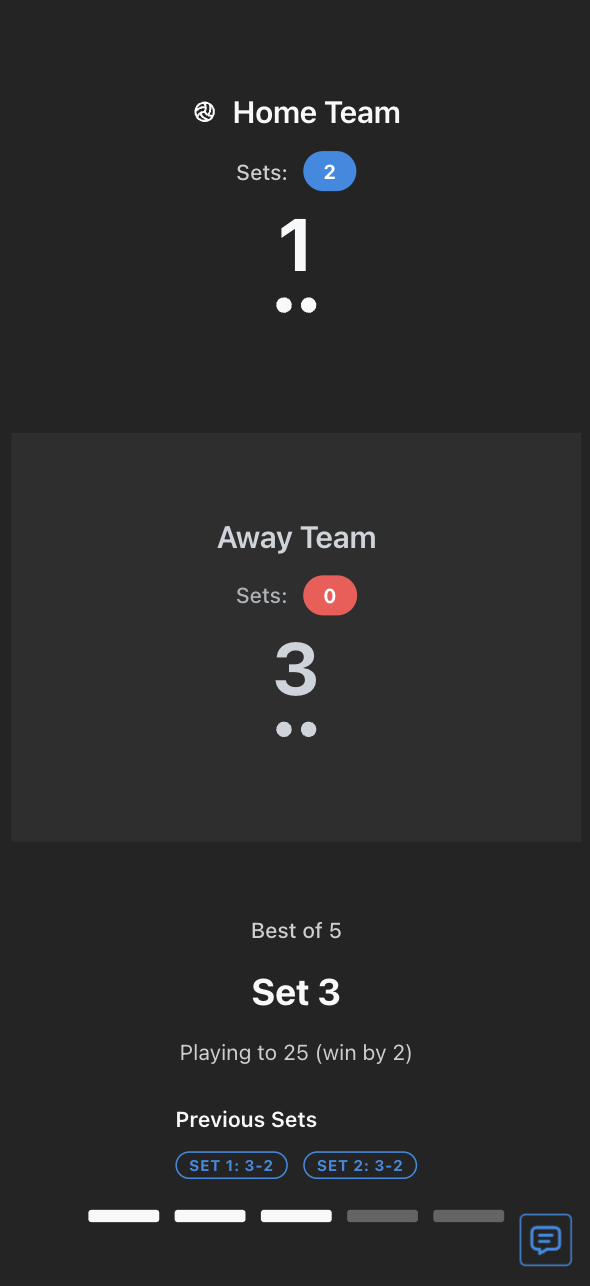
Per-Court Scoreboards
Give each court a digital scoreboard:
- Parents can follow their team's game
- No disputes about score
- Refs can focus on calls, not scorekeeping
Create free volleyball scoreboard →
Pool Play Standings
For round robin pools, a live leaderboard:
- Auto-calculates standings
- Shows set/point differentials
- Updates in real-time
Beach Volleyball Specifics
Beach tournaments have unique considerations:
Court Setup
- Net height: Same as indoor
- Court size: 8m × 16m (smaller than indoor)
- Sand depth: At least 12 inches
- Lines: Usually rope or tape
Format Differences
- 2 players per team
- Best of 3 sets to 21 (third set to 15)
- Switch sides every 7 points (5 in deciding set)
- No rotation (only 2 players)
Weather Contingency
- Wind affects play significantly
- Have delay/cancellation policy
- Start early to avoid afternoon heat
Common Problems & Solutions
"Pool play is running long"
- Reduce sets to 21 points
- Play 2 sets only (no third)
- Implement hard time caps
"Bracket seeding disputes"
- Use objective tiebreakers (set differential, point differential)
- Publish criteria in advance
- Have tournament director make final call
"Team no-shows"
- Require payment in advance
- Send reminder 48 hours before
- Have waitlist teams ready
"Not enough refs"
- Use work-team system
- Train parent volunteers
- For rec: teams self-officiate
Volleyball Tournament FAQ
How do you run a volleyball tournament?
Pick a format (round robin, single elimination, double elimination, or pool play + bracket), divide teams by skill or age, build a bracket and schedule, and assign courts and refs. Run pool play on Saturday morning, then a single-elimination playoff on Saturday afternoon for the most common weekend format. Use a digital bracket tool so winners advance automatically and parents can follow standings live from their phones.
What's the best format for a volleyball tournament?
Pool play followed by a bracket works well when every team should have several scheduled matches before elimination. A three-team pool has three matches total; a four-team pool has six. Publish how many teams advance from each pool and the tiebreak rules before registration opens.
How many courts do you need for a volleyball tournament?
Calculate match count and playing waves for your format. For example, 16 teams in four pools of four with an eight-team playoff need 31 matches. On four courts with 45-minute slots, allow 6 hours 45 minutes before breaks, rest, and officiating constraints. More divisions or longer slots change the court requirement.
How long does a volleyball tournament take?
An eight-team full round robin has 28 matches. At 45 minutes per slot on two courts, that is fourteen playing waves, or 10 hours 30 minutes before breaks. Smaller pools reduce the match count substantially. Use the format calculator and add time for your event's rest and referee requirements.
What do you need to run a volleyball tournament?
Courts with nets, refs, line judges, scorekeepers per court, scoreboards or score sheets, a bracket and schedule, balls, and a check-in table. Skill divisions matter: U14 / U16 / U18 / club / open. ScoreKeeperCo's free volleyball scoreboard, bracket maker, and leaderboard handle the score tracking; you just provide the gym and the people.
Create a free tournament bracket →
Ready to Host?
Get your tournament set up with free tools:
Good luck with your tournament!