
How to Run a Pickleball Tournament
Use the pickleball tournament planner to compare formats against your court booking. For sign-ups and entry fees, see tournament registration.
Pickleball is the fastest-growing sport in America, and everyone wants to run tournaments. Whether you're organizing a rec center round robin, a charity doubles event, or a competitive bracket tournament, this guide covers everything you need.
Choose Your Format
Round Robin (Best for Social/Rec Events)
Everyone plays everyone in their group.
Pros:
- Guaranteed multiple games per person
- More social, less pressure
- Good for mixed skill levels
- Easy to understand
Cons:
- Time-intensive
- Doesn't produce dramatic "championship" moment
- Needs consistent group sizes
Use when: You want everyone to have fun and play a lot.
Single Elimination Bracket
Lose once, you're out.
Pros:
- Quick and efficient
- Exciting knockout drama
- Works for any number of teams
- Clear champion
Cons:
- Could travel far for one game
- Bad day = done early
- Less forgiving for beginners
Use when: Time is limited or you want high-stakes competition.
Double Elimination
Lose twice, you're out.
Pros:
- One bad game doesn't end your tournament
- More games for everyone
- Fairer outcome
Cons:
- Takes roughly 2x as long
- More complex bracket
- Can be confusing to track
Use when: You have time and want fairness.
Pool Play + Bracket
Groups play round robin, top teams advance to bracket.
Pros:
- Guarantees minimum games
- Seeds the bracket based on performance
- Best of both formats
Cons:
- More complex scheduling
- Needs careful pool balance
Use when: You have 12+ teams and want both social play and competitive finals.
How Many Courts Do You Need?
Start with the format and the number of matches, then allow time for transitions, rest, and delays. A match slot is a planning assumption, not a guaranteed game duration.
Single elimination with 20-minute slots:
| Teams | Matches | 2 courts | 4 courts |
|---|---|---|---|
| 8 | 7 | 80 minutes | 60 minutes |
| 16 | 15 | 160 minutes | 100 minutes |
| 32 | 31 | 320 minutes | 180 minutes |
These estimates keep each bracket round separate and exclude breaks and extra rest. More courts cannot run the final before the semifinals finish.
For a different example, 16 teams in four pools of four, with two qualifiers per pool, need 24 pool matches plus 7 playoff matches. On four courts with 25-minute slots, that is nine playing waves, or 3 hours 45 minutes before breaks. Use the pickleball tournament planner to change the assumptions.
Skill Level Divisions
Most tournaments divide by skill rating (DUPR, UTPR, or self-rating):
Skill Levels:
- 2.0-2.5 — Beginner: Learning rules, inconsistent serve
- 3.0-3.5 — Intermediate: Consistent serve, basic dinking
- 4.0-4.5 — Advanced: Strong all-around game, strategy
- 5.0+ — Pro/Elite: Tournament winners, exceptional skill
Self-Rating System (If No Official Ratings)
Ask players to self-rate with clear descriptions:
- Beginner: Played less than 6 months, still learning rules
- Intermediate: Play regularly, can sustain rallies
- Advanced: Compete in other tournaments, strong fundamentals
- Expert: Win most games against advanced players
Event Types
Doubles (Most Common)
- Men's Doubles
- Women's Doubles
- Mixed Doubles (one man, one woman per team)
Singles
- Men's Singles
- Women's Singles
- Note: Singles requires more court space—players cover whole court
Age Divisions
Popular brackets: 19+ (Open), 35+, 50+, 65+, 75+
Fun/Themed Events
- Round robin "mixer" (random partner each game)
- King/Queen of the court
- Skinny singles (half court)
- Ladder tournaments
Registration & Sign-Ups
Information to Collect
- Name
- Email/Phone
- Skill rating or self-assessment
- Age (if age divisions)
- Partner name (for doubles)
- Shirt size (if giving swag)
- Waiver signature
Pricing
Typical entry fees:
- Casual rec event: $10-20/person
- Competitive amateur: $30-50/person
- Sanctioned tournament: $50-100/person
Factor in: court rental, balls, prizes, insurance, referee costs
Day-Of Schedule Template
16-team double elimination, 4 courts, starting 8 AM:
- 7:00 AM — Setup: Nets, signage, check-in table
- 7:30 AM — Check-in opens
- 8:00 AM — Player meeting: Rules, format, questions
- 8:15 AM — Round 1 begins
- 10:30 AM — Round 2
- 12:00 PM — Lunch break (30-45 min)
- 12:45 PM — Semifinals
- 2:00 PM — Finals
- 2:45 PM — Awards
Buffer Time Between Games
Always add 5-10 minutes between scheduled games for:
- Court cleanup
- Players switching
- Score reporting
- Bathroom breaks
Equipment Checklist
Essential
- Pickleballs (outdoor: Dura, Franklin X-40; indoor: Jugs, Onix)
- Backup balls (they crack)
- Portable nets (if not permanent)
- Printed brackets (backup to digital)
- PA system or megaphone
- First aid kit
- Scorekeeping solution
Recommended
- Canopy tents for shade
- Folding tables and chairs
- Coolers with water/ice
- Snacks
- Extension cords
- Phone chargers
- Prize table display
Scorekeeping Options
Option 1: Paper Brackets
- Print bracket on poster board
- Update with marker after each game
- Pros: No tech needed, visible to all
- Cons: Messy, hard to update, no remote access
Option 2: Digital Bracket
- Create online bracket that updates in real-time
- Share link with all participants
- Everyone can check progress from their phone
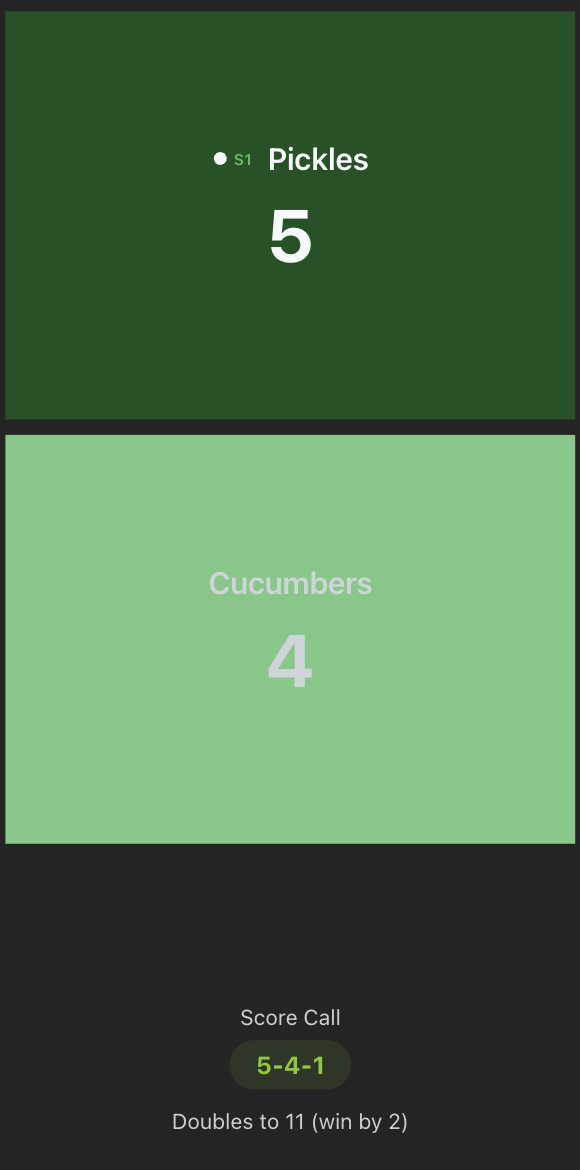
Option 3: Per-Game Scoreboards
- Each court has a digital scoreboard
- Players or refs update scores live
- Spectators follow individual games
Create free pickleball scoreboard →
Option 4: Combined Leaderboard
- For round robin: Track wins, point differential
- Auto-calculates standings
- Determines who advances to bracket play
Common Problems & Solutions
"Two teams tied in round robin"
Tiebreakers in order:
- Head-to-head result
- Point differential
- Points scored
- Coin flip
"Player disputes a line call"
- For rec play: Replay the point
- For competitive: Use refs or challenge system
- Prevention: Brief players on honor system before play
"Running behind schedule"
- Shorten games (first to 11, no win-by-2)
- Run more courts simultaneously
- Skip warm-up time
- Implement "hard time cap"—whoever's ahead when time expires wins
"Unbalanced skill levels"
- Re-bracket based on early results
- Add consolation bracket for early losers
- Next time: Require verified ratings
"Weather issues" (outdoor)
- Have indoor backup location if possible
- Set rain policy in advance (delay vs cancel)
- Communicate via text/email immediately
Money & Budgeting
For a 32-player event at $30/person:
- Revenue: $960
- Court rental (4 hours): $200
- Balls (3 dozen): $90
- Prizes: $150
- Insurance: $100
- Misc: $100
- Net: ~$320 (or reinvest in next event)
Legal Stuff
Waivers
Always have players sign a liability waiver. Include:
- Acknowledgment of physical risk
- Media release (photos/video)
- Personal responsibility for injuries
Insurance
Options:
- Facility's insurance (check coverage)
- Event insurance (one-day policies available)
- USA Pickleball membership includes some coverage
Pickleball Tournament FAQ
How do you run a pickleball tournament?
Pick a format (round robin, single elimination, or pool play + bracket), divide players by skill level (beginner / intermediate / advanced or by DUPR rating), schedule matches across your courts, and use a digital bracket or leaderboard to track results live. Skill brackets are essential — mixing skill levels makes for unfun pickleball.
What format should a pickleball tournament use?
Round robin is best for social and rec events with 4-8 teams per group — everyone plays everyone, lots of game time guaranteed. Single elimination is fastest for larger fields. Pool play + bracket combines both: round robin in pools first, top finishers advance to a single-elimination bracket. Pool play plus a bracket is a useful choice when you want several scheduled matches per team and a deciding final.
How many courts do you need for a pickleball tournament?
Court demand depends on the format. A full 16-team round robin requires 120 matches: at 25 minutes per slot on two courts, allow 25 hours of playing time before breaks. Four pools of four plus an eight-team playoff require only 31 matches. Compare formats and court counts in the pickleball planner before booking a venue.
How long does a pickleball tournament take?
With eight teams, a full round robin has 28 matches. At 25 minutes per match slot on two courts, seven rounds take fourteen waves: 5 hours 50 minutes before breaks. Set aside additional time for check-in, transitions, rest, and awards. Double-elimination timing also depends on the paths through both brackets and a possible final reset.
How do you split pickleball players by skill level?
If your event accepts DUPR ratings, you can use them to define competitive divisions such as 2.5-3.0, 3.0-3.5, 3.5-4.0, 4.0-4.5, 4.5+. For social/rec events, self-rating into beginner / intermediate / advanced is fine. Mixing skill levels creates lopsided matches and burns players out — skill brackets are the single most important fairness lever.
What do you need to run a pickleball tournament?
A bracket or round-robin schedule, courts, balls, refs (or self-officiating with a referee on call), score sheets or a digital scoreboard per court, a leaderboard for round-robin standings, and a registration list with skill levels. ScoreKeeperCo's free bracket maker, pickleball scoreboard, and leaderboard cover the score-tracking side.
Create a free tournament bracket →
Ready to Host?
Get your tournament set up with free tools:
Good luck with your event!