
How to Keep Score in Volleyball
Keeping score in volleyball means using rally scoring, where a point is awarded on every serve, until a team wins a set by reaching the target score with a 2-point lead. Rally scoring is simple: someone scores every rally. But then you get asked to keep the official book and suddenly there's rotation tracking, libero replacements, substitution limits, and timeout cards. Here's everything that actually matters.
Rally Scoring: The Easy Part
Every rally ends with a point. Doesn't matter who served—whoever wins the rally scores.
- Serving team wins rally: They score a point, same person serves again
- Receiving team wins rally: They score a point AND get the serve (this is called a "side-out")
That's it. No more side-out scoring where only servers could score. Volleyball switched to rally scoring in 1999 because games were taking forever.
When to Rotate (This Is Where People Get Lost)
Teams only rotate when they WIN THE SERVE FROM THE OTHER TEAM.
Read that again. You don't rotate every point. You don't rotate when you score. You rotate when:
- You were receiving serve
- You won the rally
- You now get to serve
The player in position 2 (front right) rotates to position 1 (back right) and becomes the new server.
If you're already serving and you score? No rotation. Same server continues.
The Six Positions
        (Net)
    4    3    2    ← Front row (can attack at the net)

    5    6    1    ← Back row (can't attack from in front of the 10-foot line)
       (Back)
Position 1 serves. After every side-out, everyone shifts one spot clockwise.
Position Faults
At the moment of serve, players must be in their correct rotational positions relative to each other:
- Each front row player must have at least one foot closer to the net than the back row player behind them
- Each player must have at least one foot closer to their sideline than the player next to them
After the serve is contacted, players can move anywhere. That's why setters sprint from back row to the net—they just have to start in position.
If a team is out of rotation when the serve happens: Point and serve go to the other team. The scorekeeper often catches this, not the refs.
Substitutions: The 18-Substitution Rule
Most high school and college volleyball allows 18 team substitutions per set.
Key details:
- Each sub counts—going IN is one, coming back OUT is another
- A player can only re-enter the set ONCE, and must return to their original rotation spot
- So Player A can start → get subbed out → get subbed back in. That's it. No third entrance.
Example: Your starting setter gets subbed out for a defensive specialist when they rotate to the back row. The setter can come back in ONE more time that set—and only for that same defensive specialist.
Running out of subs: It happens in long sets. If you hit 18 and someone gets injured, you're playing with 5.
Tracking Substitutions
The official scorekeeper records:
- Jersey number of player going out
- Jersey number of player coming in
- Which rotation position
- Running tally of total subs used
The Libero: A Whole Different Thing
The libero is a defensive specialist in a different colored jersey who follows special rules:
Libero rules:
- Can only play back row (positions 1, 5, or 6)
- Cannot serve (in most rule sets—some allow it in one rotation)
- Cannot attack the ball above net height
- Cannot set a front-row attacker from in front of the 10-foot line using overhead hand position
The key difference: Libero replacements DON'T count as substitutions. The libero can enter and exit freely—with restrictions:
- The libero can only replace one player at a time
- Must wait one completed rally before re-entering
- Can only replace players in the same position (if they replaced the middle blocker in position 6, they can only swap with that middle blocker)
Why This Confuses Scorekeepers
The libero tracking sheet is separate from normal substitutions. You're tracking:
- Which position the libero is currently playing
- Which player they replaced
- When they exit, confirming the original player returns
Most liberos replace middle blockers when they rotate to the back row (middles are typically weak passers). So you'll see: middle rotates to position 6 → libero replaces them → middle goes back in when they'd rotate to position 5.
Timeouts
Standard rules:
- 2 timeouts per set per team
- 60-75 seconds each
- Can only be called when the ball is dead (between rallies)
- Unused timeouts don't carry over to the next set
For scorekeepers: Track timeouts on the scoresheet. Refs will usually signal to you, but sometimes coaches just call them and you need to mark it.
Technical timeouts (TV/pro volleyball): Automatic timeouts at 8 and 16 points in each set. Not controlled by teams.
Set and Match Structure
Standard match formats:
- High School/College: Best of 5 sets, first four to 25, fifth set to 15
- Club: Often best of 3 sets, to 25 (or 21 for time)
- Recreational: Best of 3, sometimes to 21
Win by 2: Every set requires a 2-point margin. At 24-24, play continues until someone leads by 2. There's no cap—sets can theoretically go to 40-38 or higher.
Fifth set: Goes to 15, win by 2. Teams switch sides at 8 points.
Beach Volleyball Is Different
If you're scoring beach volleyball, the rules change:
- 2 players, not 6 (no rotation, obviously)
- Best of 3 sets, not 5
- Sets to 21, not 25 (third set to 15)
- Switch sides every 7 points (every 5 in the third set)—this accounts for sun and wind
- No substitutions—it's just the two of you
The frequent side switches mean lots of short pauses. The score might be 14-7, teams switch, then play resumes immediately.
Points That Confuse People
Net Violations
- Touching the net during a play is a fault (point for the other team)
- Exception: If it doesn't interfere with play and it's not on the top white band
- Hair or jersey touching incidentally is usually ignored
- The antenna is out of bounds—touching it or hitting the ball into it is a fault
Foot Faults on Serve
The server must stay behind the end line until after contacting the ball. Any part of the foot on or over the line at contact = point for the other team.
Back Row Attacks
Back row players CAN attack, but must jump from behind the 10-foot line (attack line). If they jump from in front of it and contact the ball above net height, it's a fault.
Back row players can land in front of the line after jumping from behind it—it's about where you jump from.
The Libero Setting Rule
If the libero sets the ball using overhead hands (not a bump) while standing in front of the 10-foot line, the attacker cannot hit the ball above net height. It's a super specific rule that refs sometimes miss.
Common Scoring Scenarios
Serving team hits the ball out: Point to receiving team, receiving team now serves (side-out).
Kill by the receiving team: Point to receiving team + side-out.
Net serve that goes over and in: Legal since 2001. Play continues.
Ball lands on the line: IN. Lines are in-bounds.
Player reaches over the net to block: Legal, as long as they don't interfere with the opponent's play before the attack.
Player touches the ball, then the ball hits the antenna: Fault on the team that touched it last.
Scorekeeper Responsibilities (The Full List)
Before the match:
- Get team rosters with jersey numbers
- Get starting lineups from both teams
- Get designated libero for each team
- Set up your scoresheet
During play:
- Track the score (obviously)
- Mark which team is serving
- Track rotation—know who SHOULD be serving each time
- Record substitutions (number in, number out, team sub count)
- Track libero replacements on the separate tracking sheet
- Track timeouts
- Track set wins
Things to watch for:
- Wrong server (you often catch this before refs do)
- Rotation errors
- Teams exceeding substitution limits
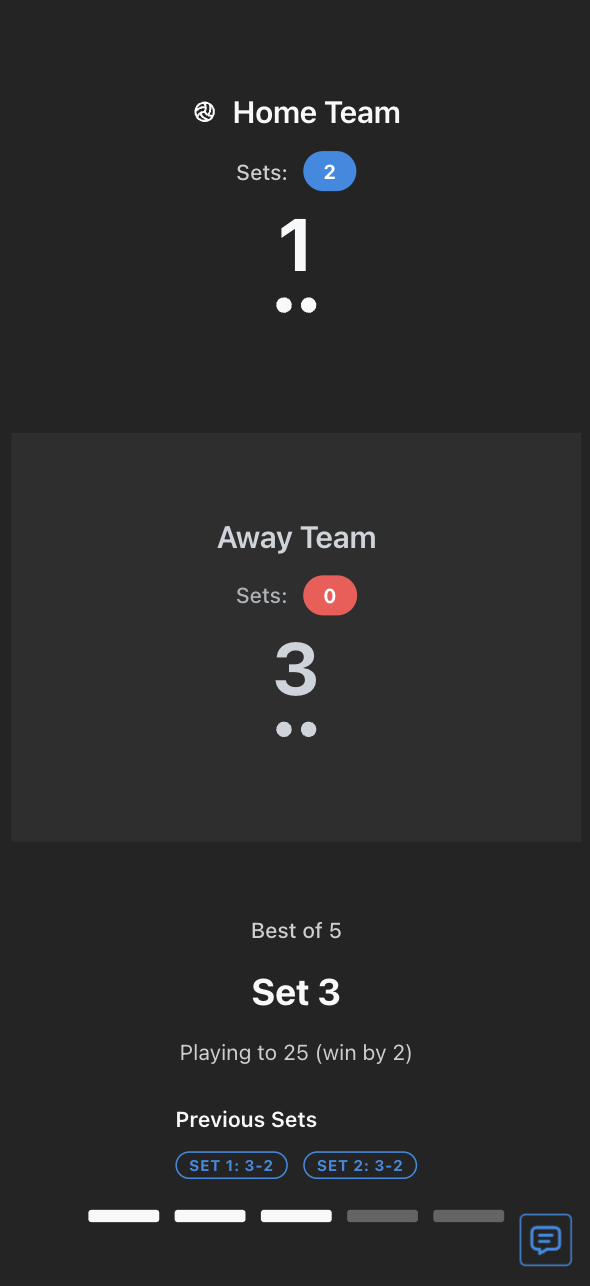
Using a Digital Scoreboard
The official paper scoresheet is required for sanctioned play. But a digital scoreboard helps everyone else:
- Parents can follow from anywhere in the gym
- No squinting at a tiny flip board
- Remote family can follow along
- Settles disputes instantly—it's right there on screen
Create a free volleyball scoreboard →
Volleyball Scoring FAQ
How does volleyball scoring work?
Volleyball uses rally scoring: a point is scored on every single rally, regardless of which team served. The first team to 25 points (with a 2-point margin) wins the set. Matches are best of 3 or best of 5 sets depending on the level. The deciding set goes to 15 points.
How is volleyball scored?
Every rally ends with a point for one team. Win the rally on your serve and you get the point. Win the rally while receiving and you get the point AND the serve (a side-out). The score format is serving team — receiving team and you call it before each serve.
How do you score in volleyball?
Hit the ball to the floor on the opponent's side, force a hitting error from the opponent, or get a block that lands in. Aces, attack errors by the opponent, ball-handling errors, and net violations all award a point. Anything that ends the rally with the ball dead on the other side scores.
How to score volleyball — the short version
- A point is awarded on every rally (rally scoring).
- Sets go to 25 (or 15 in the deciding set), win by 2 with no cap.
- A team rotates only when they win the serve from the other team.
- Match is best of 3 or best of 5 sets depending on the level.
How does scoring work in volleyball at the high school level?
High school volleyball scoring uses the same rally scoring system: best of 5 sets, first four sets to 25 points (win by 2), and a fifth deciding set to 15 (win by 2). Teams switch sides at 8 in the fifth set.
Volleyball scoring system explained
The modern volleyball scoring system is rally scoring with a 25-point set cap and a 2-point win margin. Before 1999 volleyball used side-out scoring (only servers could score), which made matches drag on for hours. Switching to rally scoring made matches predictable in length while keeping every rally meaningful.
How many points in a volleyball game?
A volleyball "game" usually means a single set — typically 25 points (or 15 for the deciding set). A volleyball "match" is the full series of best-of-3 or best-of-5 sets.
How many points to win in volleyball?
You need 25 points with a 2-point lead to win a regular set. The fifth (deciding) set is won at 15 points with a 2-point lead. There's no upper cap, so a tied set can theoretically go to 30-28, 32-30, or higher.
How many points do you play to in volleyball?
Standard sets play to 25 points, win by 2. The deciding set plays to 15. Some recreational and pool-play formats use 21 to keep matches short.
How many sets are in a volleyball game?
Most volleyball matches are best of 5 sets (high school, college, club, international). Recreational, pool-play, and some club tournaments use best of 3. Beach volleyball uses best of 3.
What does the volleyball score go to?
A regular set goes to 25 points and the fifth/deciding set goes to 15 points. Both with a win-by-2 rule. Beach volleyball sets go to 21 (or 15 in the third set).
How many points does volleyball go to?
Indoor volleyball sets go to 25 (15 in the fifth set). Beach volleyball sets go to 21 (15 in the third). Win-by-2 always applies.
What is a volleyball score keeper?
A volleyball score keeper (also written 'scorekeeper') is the person who tracks the official score, rotation, substitutions, and libero replacements during a match. The official paper scoresheet is required for sanctioned matches — you can download a free printable volleyball score sheet here. A digital volleyball scoreboard is what parents, coaches, and JV teams use to display the live score on a screen everyone can see.
Is "scoreboard volleyball" the same as a volleyball score board?
Yes — "scoreboard volleyball", "volleyball score board", and "volleyball scoreboard online" all describe the same tool: a live display of the volleyball score, sets, and serve. Run it on a TV, laptop, or projector in the gym so every player and parent can see the score from anywhere.
Open a free volleyball scoreboard online →
The Cheat Sheet
Points to win a set: 25 (15 in deciding set)
Win by: 2 (no cap)
Substitutions per set: 18 (libero replacements don't count)
Timeouts per set: 2 per team
When to rotate: Only when you win the serve from the opponent
Libero: Different jersey, back row only, unlimited replacements (with one-rally delay)
Start Keeping Score
Make scoring easier with a digital scoreboard that everyone can see:
Create Free Volleyball Scoreboard →
Running a tournament? Set up a bracket to track all your matches, and use a leaderboard for pool play standings.